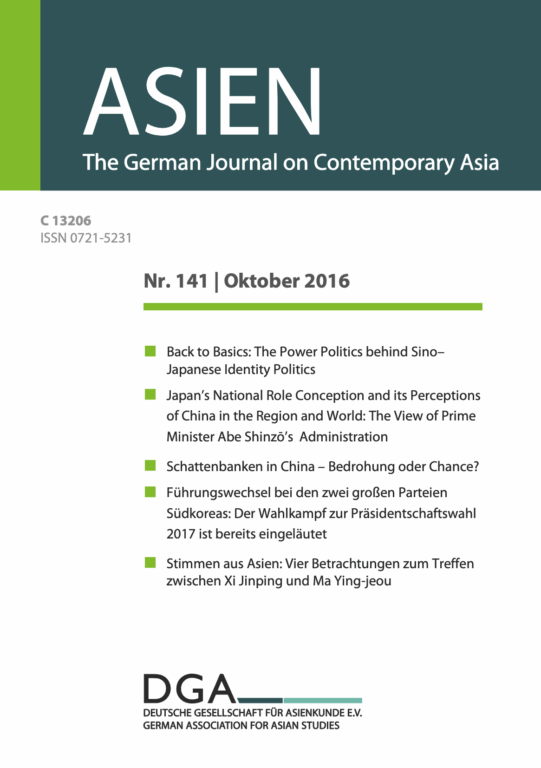
Back to Basics: The Power Politics behind Sino–Japanese Identity PoliticsGiulio Pugliese
ASIEN – Nr. 141 (2016) pp. 8–31
This article argues that the assertive Chinese and Japanese foreign and security stances of the Xi Jinping and Abe Shinzō administrations have resulted in a government-led renaissance of their respective identity politics, one qualified by top-down, adversarial nationalism. Aided by the nation-state’s communication firepower, the two governments have instrumentally insisted upon antagonistic discourses — with domestic and foreign audiences in mind. This article does not deny the many bottom-up sources of Chinese and Japanese nationalism already discovered by constructivist scholars, but introduces rather a different perspective on identity construction in Japan and China. On the basis of an array of primary sources, this article argues that the logic of Sino–Japanese identity politics has been increasingly rooted in the neoclassical realism of Sino–Japanese confrontation. Within the broader structural picture of great power competition, the Chinese and Japanese elite have engaged in a more assertive foreign policy aimed at territorial defense. Central governments enjoy leverage in defining the perimeters of discourse-making, and the nationalistic Abe and Xi administrations have mobilized public opinion following the 2012 crisis surrounding the Senkaku/Diaoyu Islands standoff.
Keywords: constructivism, neoclassical realism, propaganda, Japan–China, Victory Day parade, Abe statement