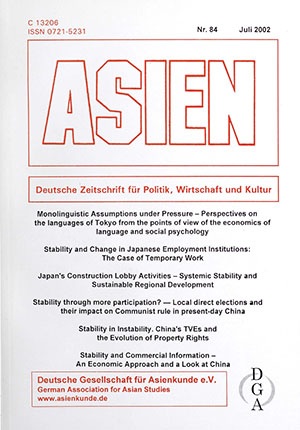
Comment: Stability Through More Participation? – Local Direct Elections and Their Impact on Communist Rule in Present-Day ChinaLianjiang Li
ASIEN – Nr. 84 (2002) pp. 56–58
Given China’s huge population and its growing importance in the world, any political reform that may affect its long-term stability and its possible transition to democracy deserves the scrutiny of political scientists. The introduction of direct election in Chinese villages is one of such reforms. As Dr. Schubert points out, Chinese leaders seem to expect that this limited democratic reform will help improve governance and enhance stability in rural China, where over 70 percent of 1.3 billion Chinese reside. In addition, some reform-minded senior leaders also seem to expect that grassroots democracy may provide democratic training to the vast peasant population. In reality, of course, no reform only produces intended consequences. In the last 15 years, direct village elections have led to a wide variety of changes. In accordance, observers have suggested a number of arguments about the impact of this reform. Some analysts in the West, for instance, have argued that grassroots democracy may constitute a growth point of democratic values in the vast rural hinterland of the largest remaining communist country. Until today, however, expectations of and arguments about what village elections may induce have remained largely either policy intentions of the Chinese leadership or scholars‘ speculations about what may happen. Few empirical studies have been conducted to examine what has happened and what is actually going on. Dr. Schubert’s research, jointly undertaken with Prof. Heberer, comes just in time. The topic he has chosen is of immense practical significance, and he is in an excellent position to bring a European perspective into the research on grassroots democracy in China. His insights are particularly refreshing and valuable in that much of the international scholarship on village elections has so far been done by scholars based or trained in the United States.