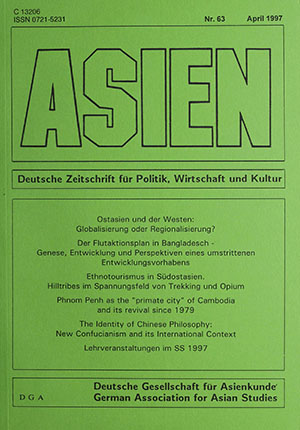
Der Flutaktionsplan in Bangladesch Genese, Entwicklung und Perspektiven eines umstrittenen EntwicklungsvorhabensMartin Peter Houscht
ASIEN – Nr. 63 (1997) pp. 36–44
Since its inception in 1988/89, the Flood Action Plan (FAP) in Bangladesh has been subject to a highly controversial discussion both within the country and in the donor countries concerned. The opponents of the FAP term it a multi-billion dollar project focusing on structural solutions and thereby ignoring the social and ecological realities of the country. The proponents praise the positive effects of flood management measures, which include not only structural interventions. More crops as a result of a green revolution „Part II“ and the protection of urban settlements are seen as their major merits. The article attempts, by presenting the key arguments of both „camps“, to place the issue of flood management in a broader, that is holistic context. The solution is not „No flood“ or „No flood control“ but „fighting bad floods (bonna) and keeping good floods (barsha)“. This, however, requires a bottom up oriented program approach rather than a top town or patronising project approach which fails to consider and grasp the interlaced variables (population, power structure, ecology, economy, etc.). Accepting the complex nature of flood management, it is necessary to redefine the role of external consultants. They should be seen as facilitators of development processes, rather than decision makers acting according to their (westernised) logical framework.