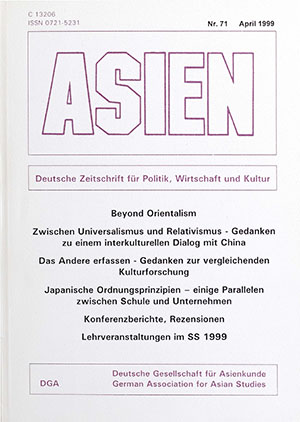
Zwischen Universalismus und Relativismus – Gedanken zu einem interkulturellen Dialog mit ChinaKarl-Heinz Pohl
ASIEN – Nr. 71 (1999) pp. 17–40
The contrary positions of China and the West concerning some of the most heatedly debated issues in the arena of international politics – human rights and democracy – can be characterized as relativistic vs. universalistic. This essay argues that these issues should not be seen from an ideological but from a historical perspective. It should be kept in mind that the present manifestations of cultures are a result of ongoing evolutionary processes of both intracultural discourses as well as intercultural exchange and assimilation. An intercultural dialogue between China and the West should be build on 1) sensitivity to other historical experiences, 2) acquisition of a core knowledge about the philosophical/religious roots of other cultures, 3) discussion of similarities and differences in the respective cultural traditions, and 4) openness and readiness to learn from one another. Hence, dialogue should not be seen as a way to lecture the partner in a student-teacher relationship but – with a hermeneutic intention – as a means to be informed by and about the other, thus leading to a process of mutual learning and to a change of views of both sides.
Es gibt kein Ding, das nicht vom Standpunkt des Nicht-Ichs aus gesehen werden könnte. Es gibt auch kein Ding, das nicht vom Standpunkt des Ichs aus gesehen werden könnte. […] Deshalb macht sich der Berufene frei von dieser Betrachtungsweise und sieht die Dinge an im Lichte der Ewigkeit. Allerdings bleibt er subjektiv bedingt. Aber das Ich ist auf diese Weise zugleich Nicht-Ich, das Nicht-Ich ist auf diese Weise zugleich Ich. So zeigt sich, daß von zwei entgegengesetzten Betrachtungsweisen jede in gewissem Sinne recht und in gewissem Sinne unrecht hat.
Zhuang Zi, „Über die Gleichheit der Dinge“
„Woran arbeiten Sie?“ wurde Herr K. gefragt. Herr K. antwortete:
„Ich habe viel Mühe, ich bereite meinen nächsten Irrtum vor.“
Bertolt Brecht, Geschichten vom Herrn Keuner