Japan (Page 6)

Studium Information Study Information {:de}Anwendungsorientierte Interkulturelle Sprachwissenschaft – Chinesisch, Japanisch (Universität Augsburg)https://www.uni-augsburg.de/de/fakultaet/philhist/studium/studiengange-a-bis-z/anwendungsorientierte-interkulturelle-sprachwissenschaft-bachelor/http://www.philhist.uni-augsburg.de/de/lehrstuehle/anis/ Zentrale Inhalte des Bachelorstudiengangs Anwendungsorientierte Interkulturelle Sprachwissenschaft sind: der Erwerb und der Ausbau sprachpraktischer Kenntnisse und Fertigkeiten in mehreren Fremdsprachen, der Erwerb von Theorie-, Methoden- und Faktenwissen mit dem Ziel des Ausbaus transkultureller kommunikativer Kompetenz der Erwerb theoretischen und methodologischen Wissens aus sprachwissenschaftlichen Disziplinen unter besonderer Berücksichtigung anwendungsorientierter Themen aus Bereichen wie Medienlinguistik, Fachsprachenlinguistik, …Bachelor Japanologie Sinologie Augsburg China Japan https://www.uni-augsburg.de/de/fakultaet/philhist/studium/studiengange-a-bis-z/anwendungsorientierte-interkulturelle-sprachwissenschaft-bachelor/http://www.philhist.uni-augsburg.de/de/lehrstuehle/anis/Zentrale Inhalte des Bachelorstudiengangs Anwendungsorientierte Interkulturelle Sprachwissenschaft sind: der Erwerb und der Ausbau sprachpraktischer Kenntnisse und Fertigkeiten in mehreren Fremdsprachen, der Erwerb von Theorie-, Methoden- und Faktenwissen mit dem Ziel des Ausbaus transkultureller kommunikativer Kompetenz der Erwerb theoretischen und methodologischen Wissens aus sprachwissenschaftlichen Disziplinen unter besonderer Berücksichtigung anwendungsorientierter Themen aus Bereichen wie Medienlinguistik, Fachsprachenlinguistik, Wörterbuchforschung, Sprachlern- und Sprachlehrforschung, Mehrsprachigkeit und Sprachkontakt, Terminologiearbeit und ÜbersetzungswissenschaftDer Studiengang umfasst die Auseinandersetzung mit drei Fremdsprachen: Englisch auf hohem Niveau, eine der drei romanischen Sprachen Französisch, Italienisch und Spanisch, jeweils auf hohem Niveau eine in der Regel neu zu erlernende Drittsprache: Arabisch, Chinesisch, Japanisch, Portugiesisch, Russisch, Schwedisch oder Türkisch bzw. Deutsch als Fremdsprache (obligatorische Drittsprache für Studierende, deren Muttersprache nicht Deutsch ist)Hinweis zu den Drittsprachen:Die Anfängerkurse in Arabisch, Chinesisch, Japanisch, Portugiesisch, Russisch, Schwedisch und Türkisch beginnen jeweils im Wintersemester, die DaF-Module im Winter- und im Sommersemester.KontaktUniversität AugsburgPhilologisch-Historische FakultätAnwendungsorientierte Interkulturelle SprachwissenschaftUniversitätsstraße 1086159 AugsburgMichaela SchäfersAkademische RätinAngewandte Sprachwissenschaft (Romanistik)Telefon: +49 821 598 – 5737E-Mail: michaela.schaefers@philhist.uni-augsburg.deMelissa HofmannStudienberatung ANISAngewandte Sprachwissenschaft (Romanistik)Telefon: +49 821 598 – 4313E-Mail: melissa.hofmann@uni-a.de AbschlüsseBachelor: BA Anwendungsorientierte Interkulturelle Sprachwissenschaft (Drittsprache Chinesisch)Master: k.A.Promotion / Graduiertenkolleg: k.A.
Studium Information Study Information {:de}Japanologie (Ruprecht-Karls-Universität Heidelberg)Die derzeitige Ausrichtung des Faches in Heidelberg spiegelt die Arbeitsfelder der Lehrkräfte wider und kann grob wie folgt umrissen werden: japanische Literatur und japanische Geschichte, Politik und Gesellschaft Japans, japanische Geistesgeschichte, ausgewählte Bereiche der Wirtschaft und der Kultur Japans. Hierbei sind die Grenzen im Bereich der Lehre weiter, in der Forschung enger gezogen. Kontakt Universität …Bachelor Japanologie Master Heidelberg Japan Die derzeitige Ausrichtung des Faches in Heidelberg spiegelt die Arbeitsfelder der Lehrkräfte wider und kann grob wie folgt umrissen werden: japanische Literatur und japanische Geschichte, Politik und Gesellschaft Japans, japanische Geistesgeschichte, ausgewählte Bereiche der Wirtschaft und der Kultur Japans. Hierbei sind die Grenzen im Bereich der Lehre weiter, in der Forschung enger gezogen.KontaktUniversität HeidelbergInstitut für JapanologieVoßstraße 2Gebäude 4120, 2. OG69115 HeidelbergSekretariatTelefon: +49 6221 54-15350sekretariat-jp@zo.uni-heidelberg.deAbschlüsseBachelor: BA Japanologie (Das Bachelorstudium Japanologie 25% kann nur als Begleitfach in Kombination mit dem Bachelor Ostasienwissenschaften studiert werden)Master: MA Japanologie (Japanese Studies) (Dieser Masterstudiengang muss mit einem Begleitfach kombiniert werden)Promotion / Graduiertenkolleg: k.A.
Studium Information Study Information {:de}Japanologie (Universität zu Köln)http://japanologie.phil-fak.uni-koeln.de/index.php?id=1239 Ein Schwerpunkt der Kölner Japanologie liegt auf einer kulturwissenschaftlich orientierten Lehre und Forschung zu Japan mit einem besonderen Fokus auf dem Zeitraum frühe Neuzeit/Edo-Zeit bis Gegenwart. Das Verständnis von Kultur ist dabei ganz im Zeichen der kritischen Cultural Studies weit gefasst. Es umfasst neben den Bereichen Hoch-, Populär- und Subkulturen auch Regional- und Alltagskulturen. …Bachelor Japanologie Master Promotion Köln Cologne Japan http://japanologie.phil-fak.uni-koeln.de/index.php?id=1239 Ein Schwerpunkt der Kölner Japanologie liegt auf einer kulturwissenschaftlich orientierten Lehre und Forschung zu Japan mit einem besonderen Fokus auf dem Zeitraum frühe Neuzeit/Edo-Zeit bis Gegenwart. Das Verständnis von Kultur ist dabei ganz im Zeichen der kritischen Cultural Studies weit gefasst. Es umfasst neben den Bereichen Hoch-, Populär- und Subkulturen auch Regional- und Alltagskulturen. Ein weiterer Schwerpunkt in Lehre und Forschung liegt im Bereich Didaktik des Japanischen. Auch wenn Lernende in der Schule schon Fremdsprachen erlernt haben, benötigen sie für das Erlernen von Japanisch zum Teil andere Lernstrategien und Vorgehensweisen. Daher haben die fachdidaktischen Lehrveranstaltungen das Ziel, Forschungsergebnisse zum Thema „Japanisch als Fremdsprache“ mit Blick auf deutsche Lernende zielgruppengerecht anzuwenden und auszugestalten. Kontakt Universität zu KölnPhilosophische FakultätOstasiatisches SeminarAlbertus-Magnus-Platz50923 Köln Telefon: +49 221 4705442 E-Mail: japanologie@uni-koeln.de (Ansprechpartnerin Anja Staab) Abschlüsse Bachelor: BA Kulturen und Gesellschaften Asiens – Schwerpunkt Japan-Studien, BA Lehramt Japanisch (Gymnasium/Gesamtschule) Master: MA Japan-Studien, M.E. Lehramt Japanisch (Gymnasium/Gesamtschule) Promotion / Graduiertenkolleg: a.r.t.e.s. Graduate School for the Humanities Cologne
Studium Information Study Information {:de}Japanologie (Freie Universität Berlin)Kontakt Freie Universität Berlin Fachbereich Geschichts- und Kulturwissenschaften Ostasiatisches Seminar Hittorf Str. 18 14195 Berlin Telefon: +49 30 838535-99, +49 30 838538-57 E-Mail: japanologie@geschkult.fu-berlin.de (Ansprechpartnerin Monika Boltz) Abschlüsse Bachelor: BA Japanstudien / Ostasienwissenschaften (Mono-Bachelor), BA Integierte Japanstudien Master: MA Japanologie Promotion / Graduiertenkolleg: Graduate School of East Asian StudiesBachelor Japanologie Master Promotion Berlin Japan Kontakt Freie Universität BerlinFachbereich Geschichts- und KulturwissenschaftenOstasiatisches SeminarHittorf Str. 1814195 Berlin Telefon: +49 30 838535-99, +49 30 838538-57 E-Mail: japanologie@geschkult.fu-berlin.de (Ansprechpartnerin Monika Boltz) Abschlüsse Bachelor: BA Japanstudien / Ostasienwissenschaften (Mono-Bachelor), BA Integierte Japanstudien Master: MA Japanologie Promotion / Graduiertenkolleg: Graduate School of East Asian Studies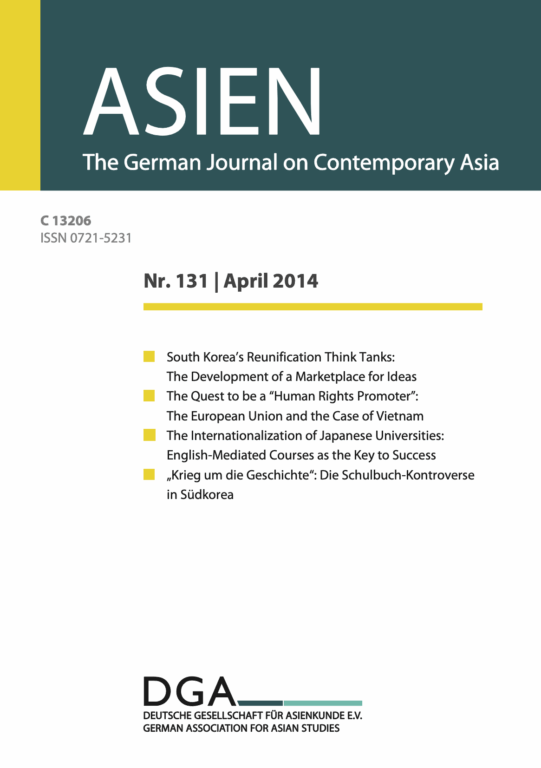 Nr. 131 (2014) Asien Aktuell 46–56 {:de}The Internationalization of Japanese Universities: English-Mediated Courses as the Key to SuccessEfforts to attract more foreign students have been driving higher-education reform in Japan for decades. In 2008, the Japanese government announced its aim of reaching 300,000 international students by 2020 with the launch of its 300,000 International Students Plan. Under the scheme, the government has been providing funding for selected core universities in an initiative …
 von by Matthias Hennings Nr. 129 (2013)
 Forschung und Lehre Research and Teaching 181–99 {:de}Einführung in die Sicherheitspolitik Ostasiens Teil 3This introductory article on East Asian security policy will appear in three parts. The first two will sketch important issue areas and outline major developments and trends. The focus will be on questions of regional order: What does security in East Asia depend on? Who creates it? Who threatens it? Part 1 discusses theoretical approaches …von by Martin Wagner- Nr. 128 (2013)
Artikel Article 28–44 {:en}Existing and Emerging Powers in the G20: The Case of East AsiaOver the last twenty years, global financial integration and global financial volatility have greatly increased. The 2008 crisis represented a peak in the vulnerability of all countries around the world with regard to global financial volatility. In response to this volatility and as the first line of defense, states have used a growing array of …von by Yves Tiberghienund and Niall Duggan
Themenschwerpunkt Feature - Nr. 128 (2013)
Artikel Article 78–92 {:en}Japan’s Role in the New Global Economic Governance: Domestic and international factorsJapan has traditionally assumed the role of regional representative in the leading mechanisms of global economic governance as the leading economic power in East Asia, historically speaking, and the only non-European/North American member of the G7/8. However, the rise of the G20, the inclusion of a number of Asian countries, and the supposed eclipse of …von by Hugo Dobson
Themenschwerpunkt Feature - Nr. 128 (2013)
Forschung und Lehre Research and Teaching 133–45 {:de}Einführung in die Sicherheitspolitik Ostasiens Teil 2This introductory article on East Asian security policy will appear in three parts. The first two will sketch important issue areas and outline major developments and trends. The focus will be on questions of regional order: What does security in East Asia depend on? Who creates it? Who threatens it? Part 1 discusses theoretical approaches …von by Martin Wagener  Nr. 127 (2013)
 Forschung und Lehre Research and Teaching 133–48 {:de}Einführung in die Sicherheitspolitik Ostasiens Teil 1This introductory article on East Asian security policy will appear in three parts. The first two will sketch important issue areas and outline major developments and trends. The focus will be on questions of regional order: What does security in East Asia depend on? Who creates it? Who threatens it? Part 1 discusses theoretical approaches …von by Martin Wagener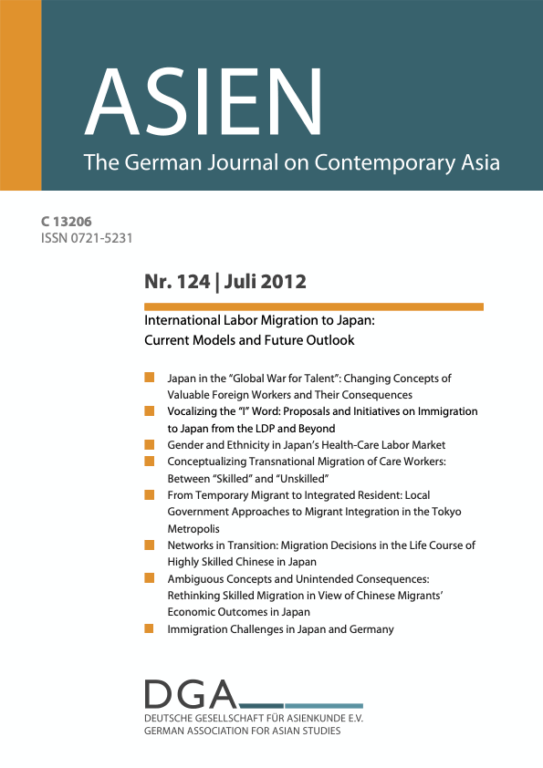 Nr. 124 (2012)
 Artikel Article 8–26 {:de}International Labor Migration to Japan: Current Models and Future OutlookA few years ago, the United Nations Population Division (UNPD) estimated that the number of international migrants would be just under 214 million in 2010. This is slightly more than the entire population of Indonesia or Brazil and means that roughly three percent of the world’s population moves around the globe (UNPD 2009). According to …von by David Chiavacci
Themenschwerpunkt Feature - Nr. 124 (2012)
Artikel Article 27–47 {:en}Japan in the “Global War for Talent”: Changing Concepts of Valuable Foreign Workers and Their ConsequencesIn recent years, under the influence of the “global war for talent,” labor immigration policies in more developed economies (MDE) have been characterized by a dichotomization regarding foreign workers’ skills. While the immigration of highly skilled foreign workers is now being actively promoted, low-skilled immigration is being curbed by increasingly restrictive regulations. According to official …von by David Chiavacci
Themenschwerpunkt Feature - Nr. 124 (2012)
Artikel Article 48–68 {:en}Vocalizing the “I” Word: Proposals and Initiatives on Immigration to Japan from the LDP and BeyondIn recent years, various influential voices in Japan have proposed that the country open itself to immigration, in one form or another, as a partial solution to revitalize the economy, to prop up the demographic decline, and in recognition of already present streams of migrants who entered through “side” or “back” doors. Where will Japan …von by Glenda S. Roberts
Themenschwerpunkt Feature - Nr. 124 (2012)
Artikel Article 69–94 {:en}Gender and Ethnicity in Japan’s Health-Care Labor MarketAs the socialization, privatization, and internationalization of health-caregiving proceeds, in many industrialized nations the health-care business, which was often a gendered labor market to begin with, is now evolving as a labor market at the intersection of gender and ethnicity. This paper addresses a bipolar concept of invisibility—and potential vulnerability—of female labor migrants through the …von by Gabriele Vogtund and Phoebe Holdgrün
Themenschwerpunkt Feature - Nr. 124 (2012)
Artikel Article 95–114 {:en}Conceptualizing Transnational Migration of Care Workers: Between “Skilled” and “Unskilled”The demographic change, resulting from a low fertility rate and an aging society, has led policy makers and business sectors to rethink Japan’s future population prospects. Although Japan has been considered an anomaly among the industrial democracies in not depending on foreign labor to pursue its economic goals, the acceptance of highly skilled migrants is …von by Reiko Ogawa
Themenschwerpunkt Feature - Nr. 124 (2012)
Artikel Article 115–36 {:en}From Temporary Migrant to Integrated Resident: Local Government Approaches to Migrant Integration in the Tokyo MetropolisIn January 2011, the Tokyo Metropolis (TM) was home to more than 420,000 registered migrants, or 3.24 percent of the total metropolitan population. At the micro level, local governments in the TM such as Shinjuku have populations of migrants representing eleven percent of the population or more, implying that parts of Tokyo are becoming significant …von by Stephen Robert Nagy
Themenschwerpunkt Feature - Nr. 124 (2012)
Artikel Article 137–58 {:en}Networks in Transition: Migration Decisions in the Life Course of Highly Skilled Chinese in JapanIn recent years, Japan has increased its efforts to recruit highly qualified Chinese migrants; on the other side of that coin, China has also made efforts to bring its highly qualified emigrants back home. These students and workers fulfill important functions connecting the two countries economically, culturally and academically. Yet, it is not clear how …von by Ruth Achenbach
Themenschwerpunkt Feature - Nr. 124 (2012)
Artikel Article 159–79 {:en}Ambiguous Concepts and Unintended Consequences: Rethinking Skilled Migration in View of Chinese Migrants’ Economic Outcomes in JapanImmigration policy makers tend to have preexisting notions about categories such as “international students” and “skilled” or “unskilled” migrants. They often design and implement immigration policies according to the observable labor shortage at any given time. There are two caveats in this approach. First, these common-sense categories adopted in immigration policy making are in reality …von by Gracia Liu-Farrer
Themenschwerpunkt Feature - Nr. 124 (2012)
Artikel Article 180–97 {:en}Immigration Challenges in Japan and GermanyWith its stubborn denial of immigration except for the highly qualified, Japan has long been considered a strange outlier among the rich nations. However, it is quite ironic that these days all other rich countries have adopted this mantra: let in the best and the brightest, keep out the unqualified. All over Europe there is …von by Dietrich Thränhardt
Themenschwerpunkt Feature 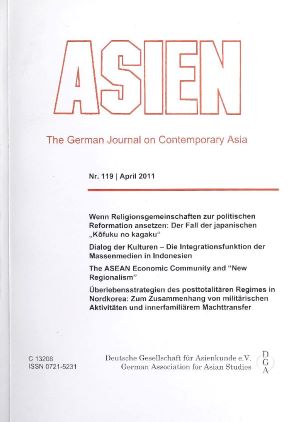 Nr. 119 (2011) Editorial 5–7 {:de}Verborgene Aspekte der KatastropheDas große Hanshin-Erdbeben vom 17. Januar 1995 hatte eine Stärke von 7,3 auf der japanischen Skala. Es forderte 6434 Todesopfer und ca. 44.000 Verletzte. 100.000 Gebäude wurden völlig zerstört. Die geschätzte Gesamtsumme der Schäden betrug 75 Mrd. Euro. Diese Katastrophe wird von der des mit einem gigantischen Tsunami verbundenen Erdbebens in Tohoku am 11. März …
 von by Florian Coulmas- Nr. 119 (2011)
Artikel Article 9–25 {:de}Wenn Religionsgemeinschaften zur politischen Reformation ansetzen: Der Fall der japanischen „Kōfuku no kagaku“While the relationship between religion and politics has gained more and more attention among social scientists since the early 1980s, the case of Japan has been widely ignored. Given the circumstances (no religious conflicts, constitutional separation of state and religion) this is not surprising, but those religious organizations that participate in various forms in Japanese …von by Axel Klein 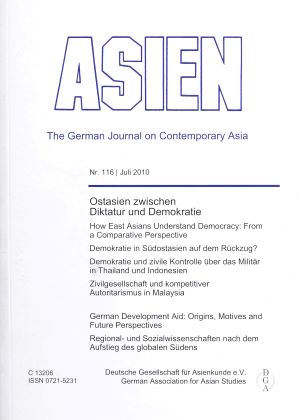 Nr. 116 (2010) Editorial 8–15 {:en}The rise of China and India – repercussions for Japan (Wissenschaftliche Tagung der DGA, 15.05.2009)Thank you very much for your kind introduction. It is a great pleasure for me to be here in Berlin again. As a member of the Japan-German Dialog Forum, I have been a regular visitor here at least every two years for more than 10 years. One big difference is that we are now in …
 von by Shinichi Kitaoka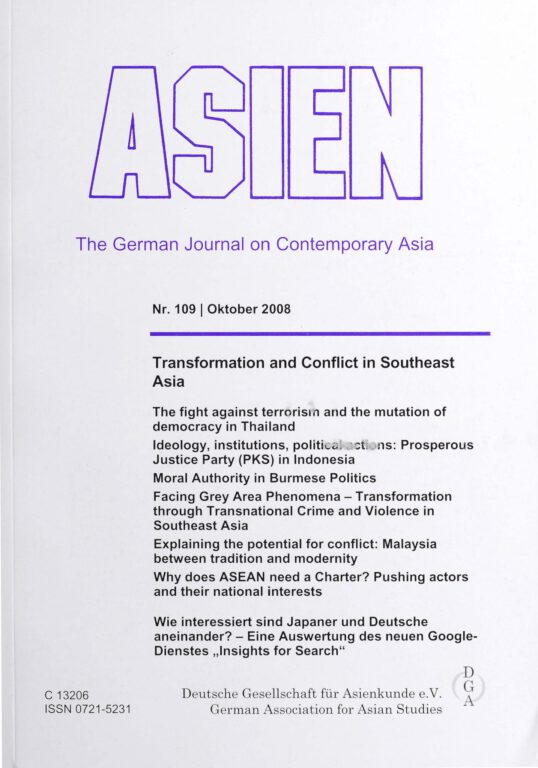 Nr. 109 (2008) Asien Aktuell 88–95 {:de}Wie interessiert sind Japaner und Deutsche aneinander? – Eine Auswertung des neuen Google-Dienstes „Insights for Search“Der neue kostenlose „Insights for Search“-Dienst von Google (google.de/insights/search) erlaubt wertvolle Einsichten in die Informationsnachfrage und die Interessenfelder von Individuen, die sich im Internet bewegen, etwa im deutsch-japanischen Kontext. Damit sind jetzt fundiertere Aussagen dazu möglich, ob sich z.B. durch Veranstaltungen wie das Deutschlandjahr in Japan 2005/06 die bilaterale Aufmerksamkeit steigern lässt. Das deutsch-japanische Verhältnis …
 von by Werner Pascha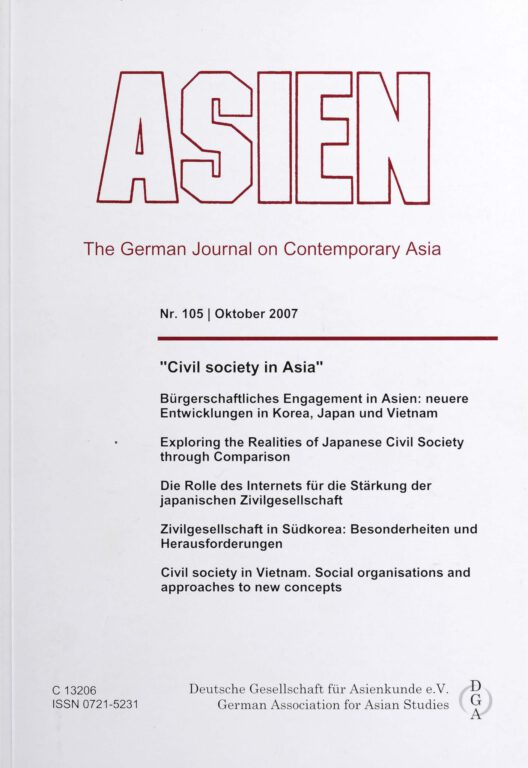 Nr. 105 (2007)
 Artikel Article 7–15 {:de}Einleitung – Bürgerschaftliches Engagement in Asien: neuere Entwicklungen in Korea, Japan und VietnamThe emergence of a vivid civil society in Asian countries has become the focus of scientific interest for at least one decade. Until now some international surveys have presented basic data concerning the quantity and quality of civil society in various Asian countries. They allow rough descriptions concerning similarities and differences. South Korea, Japan and …von by Gesine Foljanty-Jost
Suchen Search
Schlagwörter Tags
Aktuelles von unseren Mitgliedern Member News (3)- Art (5)
ASIEN (Zeitschrift) ASIEN (Journal) (16)Auszeichnung Award (12)Bericht Report (127)Bildung Education (22)- Calls for… (1230)
- Cinema (4)
- DGA (89)
Diskussion Roundtable (73)- Fellowship (111)
Forschung Research (225)- Geografie (2)
Geschichte History (93)Gesellschaft Society (277)Globalisation Globalization (7)- Hybrid (172)
Kultur Culture (25)- Kunst (4)
- Lecture (94)
Literatur Literature (260)Medien Media (24)- Migration (39)
- Nationalism (6)
- Online (235)
Philosophie Philosophy (12)Politik Politics (414)Politikwissenschaften Political Sciences (13)- Praktikum (8)
- Präsentation (13)
Programm Program (5)Publikation Publication (22)Recht Law (20)- Religion (75)
- Sozialwissenschaften (4)
Sprache Language (36)- Sprachkurse (8)
Stellenausschreibung Job Advertisement (654)Stipendium Grant (52)Studium Study (21)- Summer School (10)
Symposium Symposia (32)Tagung Conference (498)Tourismus Tourism (14)Umwelt Environment (45)Veranstaltung Events (750)- Webinar (28)
Wirtschaft Economy (199)- Workshop (126)
Arbeitskreise Working Groups Working Groups
Kategorien Category
- ASC (31)
- DGA News (57)
Nachwuchsgruppe YSG (62)Neuzeitliches Südasien South Asia (12)Südostasien Southeast Asia (1)
Browse by
Länder Country
- Afghanistan (30)
Afrika Africa (22)- ASEAN (48)
Asien Asia (580)Asien-Pazifik Asia-Pacific (63)Australien Australia (4)- Austronesien (3)
Bangladesch Bangladesh (30)- China (1496)
- Deutschland (3)
Eurasien Eurasia (2)Europa Europe (36)- Fiji (3)
- Hong Kong (95)
Indien India (225)Indochina Indo-China (5)Indonesien Indonesia (95)- Japan (506)
Kambodscha Cambodia (30)- Korea (208)
- Laos (5)
- Lateinamerika (2)
- Macau (4)
- Malaysia (30)
Mongolei Mongolia (57)- Myanmar (17)
Naher Osten Middle East (10)- Nepal (9)
Neuseeland New Zealand (4)Ostasien East Asia (289)Osttimor East Timor (4)- Pakistan (31)
Papua-Neuguinea Papua New Guinea (5)Philippinen Philippines (34)Rußland Russia (14)Singapur Singapore (24)- Sri Lanka (25)
Südasien South Asia (170)Südostasien South-East Asia (235)- Taiwan (334)
- Thailand (41)
- Tibet (19)
UdSSR USSR (13)- USA (57)
- Uzbekistan (2)
- Vanuatu (2)
- Vietnam (46)
Zentralasien Central Asia (41)
Mitgliedschaft Membership Membership
Orte Locations
- Amsterdam (3)
- Augsburg (3)
- Berlin (107)
- Bielefeld (2)
- Bochum (23)
- Bonn (33)
- Bremen (19)
- Duisburg-Essen (44)
- Erfurt (3)
- Erlangen-Nürnberg (16)
- Frankfurt am Main (33)
- Freiburg (28)
- Göttingen (14)
- Halle (12)
- Hamburg (61)
- Heidelberg (36)
- Jena (7)
- Kiel (3)
Köln Cologne (29)- Konstanz (6)
- Kopenhagen (2)
- Leipzig (17)
- Ludwigshafen am Rhein (2)
- Mainz (3)
- München (6)
- Münster (5)
- Passau (6)
- Rostock (8)
- Stuttgart (2)
- Trier (8)
- Tübingen (40)
Wien Vienna (42)- Würzburg (17)
Zürich Zurich (10)