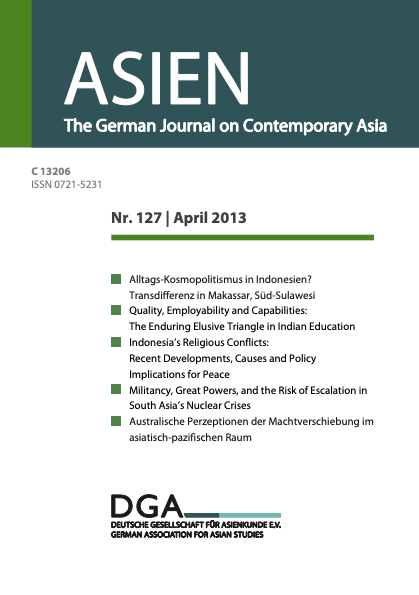
Australische Perzeptionen der Machtverschiebung im asiatisch-pazifischen RaumThomas Prinz
ASIEN – Nr. 127 (2013) pp. 79–94
The shift in discussion among Australia’s political and intellectual elite over the last decade could be aptly summarized with the words “It’s the geography, stupid!” Today’s question of concern is no longer about British heritage and Asian geography, as was the case three decades earlier. Instead, the burden (and opportunities) due to the country’s geography have finally prevailed.
There is currently one question in Australian foreign and strategic policy that matters more than any other: How should Australia respond to the shifting dynamics of the great powers in the region? The starting point of this discussion was the publication of Hugh White’s analysis “Power Shift: Australia’s Future between Washington and Beijing” in 2010. After more than two years of extensive debate, the options appeared to be clear: Stakes had been set anywhere between armed neutrality and
an even closer strategic partnership with the United States, or rather, between massive rearmament and a pragmatic “no worries” policy.
In fact, discussion about the matter revealed that “power shift” means more than a relative decline in US power and the rise of China. How are India, Japan, Korea, and Indonesia reacting to this changing political situation? Which new coalitions could possibly emerge, and what role can the region’s security architecture play? Australia is currently in an unstable international environment: Military expenditures are on the rise (not only in China, but in the whole region), numerous territorial disputes remain unsolved, the lack of conflict-resolution mechanisms is evident, and nationalism is getting stronger while the future role of the USA in the region is unclear. The discussion of these questions is therefore more than just a friendly academic exchange of opinion for the Australian security-policy community.