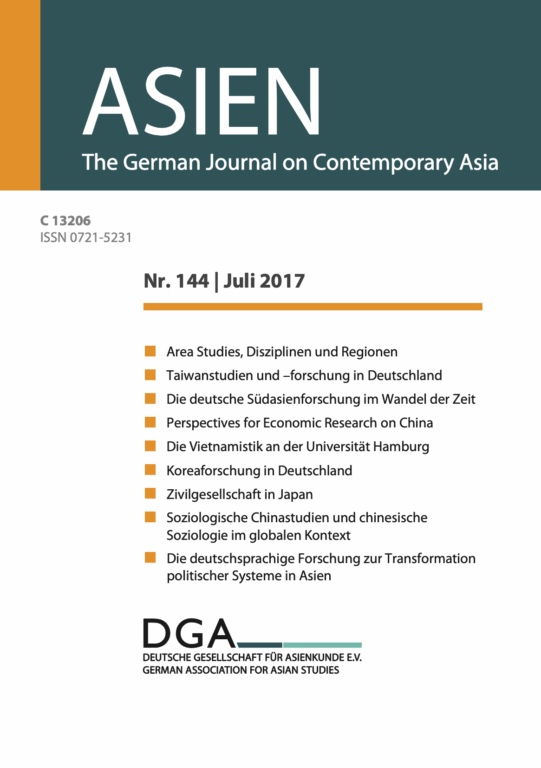
Die deutschsprachige Forschung zur Transformation politischer Systeme in Asien – Perspektiven, Profile und BefundeAurel Croissant
ASIEN – Nr. 144 (2017) pp. 135–51
German scholars have long neglected the analysis of political transformation processes in South, Southeast, and Northeast Asia. Only since the end of the 1990s have researchers in Germany developed an interest in this international, mostly English-language, literature. In contrast, German-language political science democratization research on Asia has long been well established. As in North America, the boundaries between democratization and autocracy research have become blurred in recent years — while the close link between democracy and dictatorship research is a welcome development. Theoretically and methodologically, the German language transformation research on Asia has made only a comparatively small contribution to international political science research. Its main advance has been in its in-depth analysis of individual or select cases. In order to remain internationally pertinent and to become more widely accepted, German-language research henceforth needs to be more methodologically nuanced as well as to embrace the triangulation of data and mixed-methods research designs.
Keywords: Democratization; authoritarianism; Asia; comparative method; political institutions; structures; agency