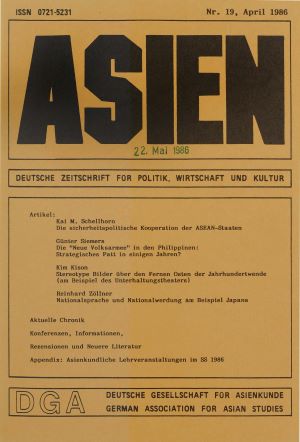
Die „Neue Volksarmee“ in den Philippinen: Strategisches Patt in einigen Jahren?Günter Siemers
ASIEN – Nr. 19 (1986) pp. 20–43
A leading young Maoist expelled in 1967 from the Moscow-leaning „Partido Komunista ng Pilipinas“, Jose Maria Sison (alias Amado Guerrero), was instrumental in the setting-up of a „Communist Party of the Philippines“ (CPP) in 1968 and its „military arm“, the „New People’s Army“ (NPA), in 1969 – both of which have been outlawed by the government. The NPA is also active in the political field. It meanwhile has either infiltrated or is influencing 14% of the country’s 41,500 barangays (villages), is present in 62 of the Philippine’s 73 provinces and has reached an estimated strength of some 25,000 guerillas (only about half of whom are armed) – as compared to 157,000 soldiers, plus militia and police, on the government side. The clearly stated aim of the CPP/NPA is to take over the government of the Philippines. To this end, the CPP through the NPA now wages a „people’s democratic revolution“, trying to join forces with other hard-core antigovernment groups which, after serving their purpose, would loose all influence during the second stage of the (official) communist strategy, a „socialist revolution“ eventually leading to a dictatorship of the proletarian class. Although the NPA so far mostly has taken care of its logistical needs itself through „taxation“, capture of arms and supplies from government troops etc., there now is increasing speculation that it may have reached a size where aid from abroad soon will be a necessity. With the Marcos government loosing more and more popular support and poverty growing, the immediate aim of the NPA, a „strategical stalemate“ within the next five (or more) years, did not appear entirely beyond grasp. Even after the recent change of government, the most likely long-range alternatives seem to be either a communist victory, or a government based on the military, or major social reforms.