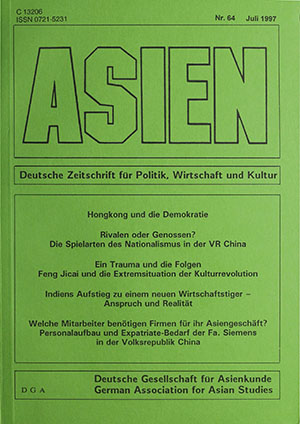
Hongkong und die DemokratieBert Becker
ASIEN – Nr. 64 (1997) pp. 7–26
In contrast to many authoritarian regimes worldwide, Hong Kong’s colonial system has earned a high level of legitimacy because of its respect against civil liberties, the maintenance of a reasonable degree of political and social stability, the visible success of the economic system and the expanding welfare program. The political apathy of the HK people waned already in the 1970s, in the 1980s the population got involved in politics and in the 1990s the society became politicized. HK’s democratization process was an anomalous case because it does not fit to decolonization concepts and modernization theories. The main reason for that had been the division of the middle class by the ‚China factor‘. In future HK will develop a political system which will gradually displaying the characteristics of Macau’s and of Singapore’s political system. This „Hong Kong Model“ preserves the colonial and authoritarian executive‐led government with a low degree of influence by the legislature. But HK is now the first place within China to have a genuine multi‐party system operating in accordance with a unique institutional framework of „one country, two systems“. It seems possible that in the long run HK will become a model for China’s own democratization.