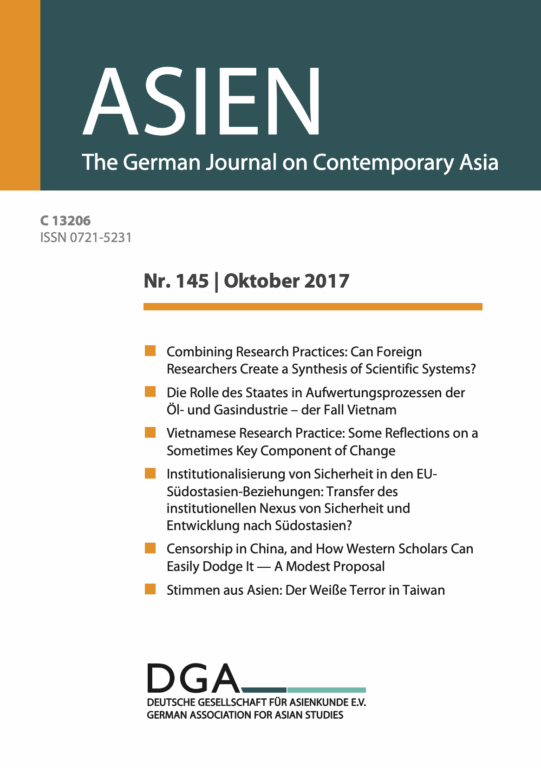
Institutionalisierung von Sicherheit in den EU-Südostasien-Beziehungen: Transfer des institutionellen Nexus von Sicherheit und Entwicklung nach Südostasien?Naila Maier-Knapp
ASIEN – Nr. 145 (2017) pp. 65–74
Since the ratification of the Treaty of Lisbon, considerable institutional adaptation has
taken place to manage the overlapping areas or the nexus between the EU’s security
and development policies. Current plans of the European Commission’s Service for
Foreign Policy Instruments (FPI) to build up structures suggest that this nexus is
furthermore driving externalization and external institutionalization efforts of FPI, in
particular in relation to FPI’s Instrument contributing to Stability and Peace (IcSP) in
Southeast Asia. This envisaged institution-building beyond the EU’s borders implies
a transfer of the security-development nexus debate and pertinent responsibilities
from the Brussels headquarters of FPI to the corresponding structures on site. This
thus begs the question whether — if at all — the effectiveness of IcSP in Southeast
Asia can be improved through an institutional shift of the nexus debate? Can inter-
institutional issues of the EU arising from the nexus be attenuated or even dissolved
through externalization processes? In light of the ongoing violent conflicts in Rakhine
State and Marawi City at the time of writing, questions about effective crisis response
and management in Southeast Asia are more relevant than ever and demand
attention to the potential of international assistance providers, namely the EU’s
evolving security actor capability.
Keywords: security-development nexus, Instrument contributing to Stability and
Peace (IcSP), EU-ASEAN relations, development cooperation, regional
integration, EU foreign policy, Southeast Asia