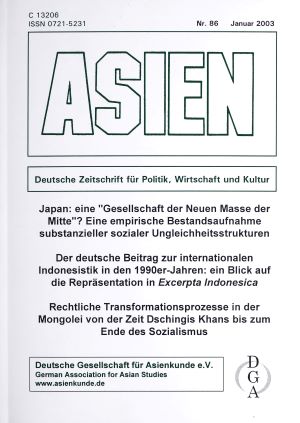
Japan: eine „Gesellschaft der Neuen Masse der Mitte“? Eine empirische Bestandsaufnahme substanzieller sozialer UngleichheitsstrukturenMasao Watanabe und and Carmen Schmidt
ASIEN – Nr. 86 (2003) pp. 5–19
At least since the middle of the 1970’s it is a widespread view among the mainstream of Japanese social sciences to regard Japanese society to be exceptionally equal, distinctively peaceful and uniquely integrated. This view may have deterred sociologists from investigation of social inequalities. The aim of this paper is to make clear the fact that there are social inequalities in contemporary Japan under the façade of a classless and extraordinarily homogenous society, and to highlight that these inequalities are deeply embedded in various institutions, such as labour market, educational system and family structure. By empirical investigation of the distribution of societal resources like income, wealth or education we want to show that not only the claim of Japan being a „new middle mass society“ is based upon wrong assumptions, but also the actual debate among Japanese social scientists about the breakdown of this new middle mass, which is closely related to the sincere crisis of Japanese economy in the 90’s.