Dietmar Rothermund
 Nr. 116 (2010) Asien Aktuell 103–13 {:en}German Development Aid: Origins, Motives and Future PerspectivesThe German state is heavily indebted. Should it continue to provide aid to developing countries? Some countries like China and India, which spend a great deal on aiding developing countries themselves, still receive millions of euros of German aid. A revision of German aid policy seems to be due. Moreover, there are several agencies administering …
 von by Dietmar Rothermund
Themenschwerpunkt Feature  Nr. 114/115 (2010) Editorial 9–10 {:de}Zum 80. Geburtstag von Theo SommerWer Theo Sommer begegnet, wird von seinem jugendlichen Schwung beeindruckt und kann kaum fassen, dass dieser lebensvolle Mann nun schon 80 Jahre alt ist. Bei aller Energie, die in ihm wohnt, wirkt er nie gespannt oder gar verkrampft, es ist eine lässige Energie, die er ausstrahlt und die andere Menschen in ihren Bann zieht. Er …
 von by Dietmar Rothermund Nr. 112/113 (2009) Asien Aktuell 123–29 {:en}Congress Comeback in the Indian Elections of 2009The parliamentary elections held in four phases from April to May 2009 sprung a surprise on everybody concerned. Nobody had been able to predict the triumphant comeback of the Congress party. A neck-to-neck race with the Bharatiya Janata Party (BJP) was expected, and as voters often turn against the incumbent, a swing toward the BJP …
 von by Dietmar Rothermund Nr. 92 (2004) Asien Aktuell 87–89 {:en}‚Landslide‘: Surprising Results of the Elections in IndiaIndians like to talk about a ‚landslide‘ when elections lead to an unexpected change of government as they did in May 2004. Hearing about such a dramatic event one would expect that a massive shift of the national vote produced such results. But the majority election system which India has inherited from the British often …
 von by Dietmar Rothermund Nr. 80 (2001)
 Artikel Article 116–25 {:en}Europe and India: The Need for Greater Mutual AwarenessThe EC is poised to accept several East-European states as new members. In this way it will be preoccupied with its own integration and will not pay much attention to developments in distant places such as India. A consolidated „Little Europe“ would certainly be more effective in dealing with the outside world, but it seems …von by Dietmar Rothermund Nr. 79 (2001)
 Artikel Article 87–91 {:en}Creating New States in India: Chattisgarh, Jharkhand, UttaranchalIndian federalism is a very flexible institution. Due to its centralist bias it can be easily used by the Government of India for its own ends. This has now been demonstrated by the present coalition government led by the Bharatiya Janata Party (BJP) which has created three new states by means of „reorganisation“ acts passed …von by Dietmar Rothermund Nr. 68 (1998)
 Artikel Article 5–20 {:en}The Fall-out of a New Political Regime in IndiaEine „rechte“ Koalition geführt von der Bharatiya Janata Party (BJP) hat das „Congress System“ abgelöst, das darin bestand, daß sich eine „Zentrumspartei“ durch die Polarisation von rechter und linker Opposition an der Macht erhielt. Wahlallianzen der BJP haben regionalen Parteien zu Sitzen verholfen, die früher im Schatten der nationalen Parteien standen. So verschaffte sich die …von by Dietmar Rothermund Nr. 39 (1991)
 Artikel Article 21–31 {:en}Problems of Parliamentarism in IndiaDer Autor untersucht die inner-indischen Auseinandersetzungen um Parlamentarismus und Föderalismus und die Entwicklung des parlamentarischen Systems von der Zeit des Unabhängigkeitskampfes bis zur Wahlniederlage der Congress Party 1989 bzw. zum Konflikt in Ayodhya 1990. Er zeigt die verschiedenen Aspekte des „britischen Erbes“ auf (Vizekönigliche Vollmachten, Gouverneure) und verweist darauf, daß der INC sich nach Ghandis …von by Dietmar Rothermund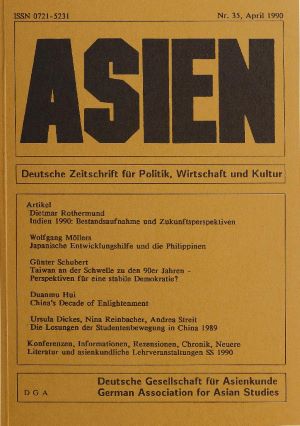 Nr. 35 (1990)
 Artikel Article 5–12 {:de}Indien 1990: Bestandsaufnahme und ZukunftsperspektivenDer Aufsatz gibt einen Überblick über innenpolitische Herausforderungen (soziale und politische Probleme), den Fall Sri Lanka als außenpolitische Erblast, Aufgaben der Wirtschaftspolitik (die Durchsetzung einer binnenwirtschaftlichen Liberalisierung, die mit der außenwirtschaftlichen Schritt hält), die Entwicklung der ausländischen Privatinvestitionen in Indien und das Haushaltsdefizit und die Zahlungsbilanzprobleme.von by Dietmar Rothermund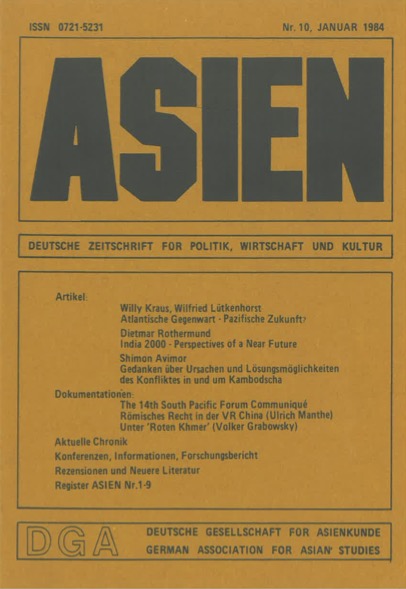 Nr. 10 (1984)
 Artikel Article 22–38 {:en}India 2000 – Perspectives of a Near FutureThe author traces the trend of development in agriculture and industry, looks at urbanization and the problems of a deteriorating environment and assesses the potential performance of the political system. Intensification of agriculture is necessary as the area under cultivation cannot be extended any longer.von by Dietmar Rothermund