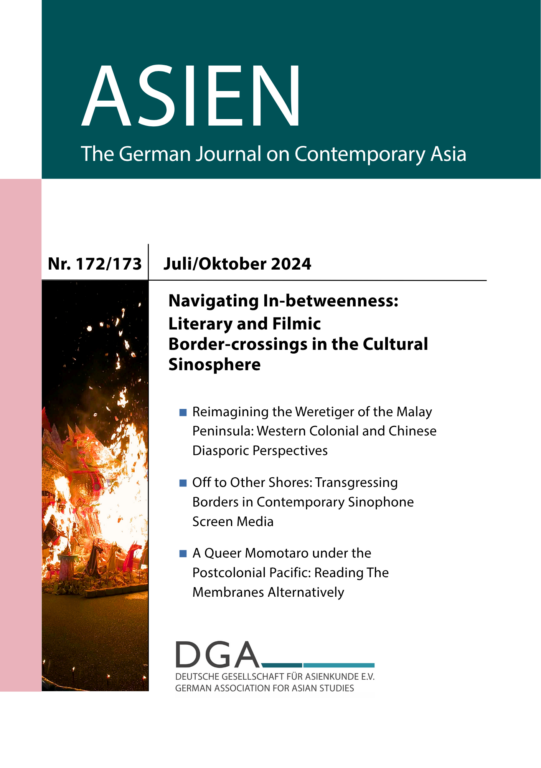
A Queer Momotaro under the Postcolonial Pacific: Reading The Membranes AlternativelySophia Huei-Ling Chen
ASIEN – Nr. 172/173 (2024) pp. 69–90
In this article, I read The Membranes (1996, 2021) as a postcolonial subversion of the Japanese folktale Momotaro, an interpretation alternative to the dominant reading mode that interprets the novella exclusively as science fiction. Examining the novella’s reader reception of its English translation, I suggest that the dominant reading mode in English-speaking communities tends to overlook the author’s speculation upon the reshuffling of global order and the postcolonial parable of Taiwan refracted by the protagonist’s birth story. While the dominant interpretive mode contributes to the great success of The Membranes’ translation, I argue that this mode eclipses the story’s postcolonial parable and constitutes an inverted form of “the time lag of allegory” identified by Shu-mei Shih as perpetuating the power asymmetry between the West and the non-West in global literary studies (2004). A reading that contests this mode is due. Published in Taiwan in 1996 when the gates had just been thrown open to eclectic borrowing as well as genre and gender subversion—as Taiwan ended its 39-year long martial law period in 1987—the novella projected a nationalistic as well as queer speculation from the author Chi Ta-wei—in a postapocalyptic world where humanity has relocated underseas (and where heterosexuality is abnormal), Taiwan exerts a huge regional influence, dominating Southeast Asia. Certainly a counterfactual, this fantasy likely gratified Taiwanese readership back then and can still strike a profound chord with its people now—as the island continues to be a politically inchoate state. With the birth story of its protagonist Momo (punning on the Japanese for “peach”) as its main plotline, The Membranes is allegorical of modern Taiwan, especially of its modern origin. This article provides an alternative reading strategy to emphasize this novella’s cultural specificities. It shows that underneath its sci-fi and queer trappings, The Membranes, at a deeper level, reflects Taiwan’s anxiety as a small and inchoate state as well as its story of modern origin.