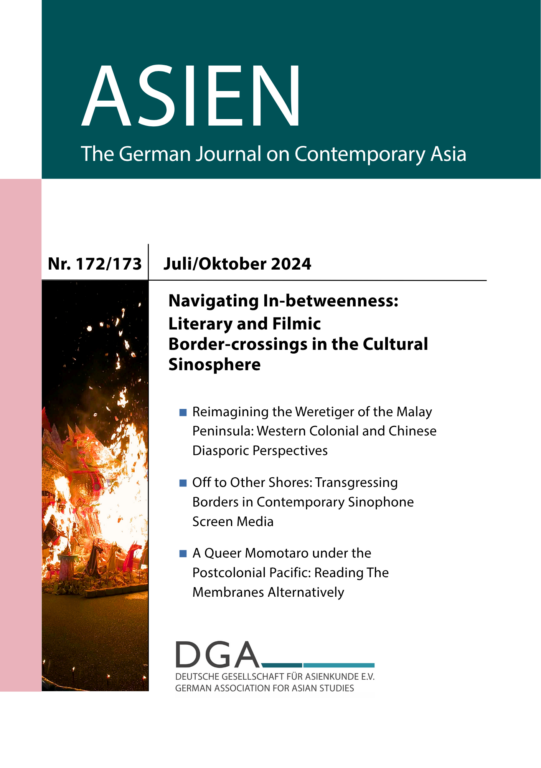
Off to Other Shores: Transgressing Borders in Contemporary Sinophone Screen MediaHelen Hess
ASIEN – Nr. 172/173 (2024) pp. 41–68
The concept of a border is most commonly understood in a geographical sense, referring to boundaries between nation states or specific locations, which are often fluid rather than clearly demarcated. However, borders can also denote boundaries between different materials, ontological states, or realms of existence. In Chinese folk religion, for instance, physical objects are believed to cross into the metaphysical realm through processes such as burning or vaporization, while humans employ various strategies to communicate with spirits and the dead. This paper examines how young women traverse the boundaries between the physical and metaphysical realms in contemporary Sinophone filmic narratives, focusing on the interplay between representations of supernatural phenomena, spirituality, and the negotiability of reality and identity with broader social realities and cultural discourses. Central to the analysis is the Netflix mini-series Bi’an zhi jia 彼岸之嫁 (English title: The Ghost Bride), an adaptation of Yangsze Choo’s novel The Ghost Bride, set in late nineteenth-century colonial Malacca. The series follows Pan Lilan, a young woman forced into a ghost marriage who must enter the realm of the dead to confront supernatural violence and reclaim agency. The paper places The Ghost Bride—referring both to the Netflix series and the novel—in conversation with Tan Chui Mui’s Barbarian Invasion (Chinese title: Yemanren ruqin 野蛮人入侵; Malay title: Belenggu), which offers a contemporary Sinophone perspective on spiritual and embodied forms of border-crossing beyond explicit ghostly encounters. Through an intersectional lens, this paper investigates how these transgressions and mediations—and the resulting states of in-betweenness—reflect and challenge gendered, classed, and ethnic hierarchies, arguing that such narratives offer imaginative blueprints for coexistence and plurality in the contemporary Sinophone world.