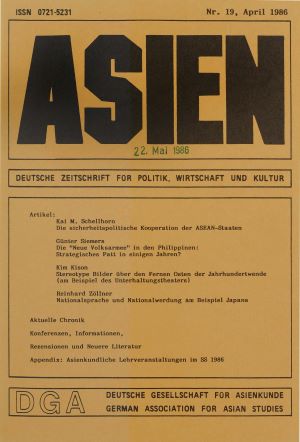
Nationalsprache und Nationalwerdung am Beispiel JapansReinhard Zöllner
ASIEN – Nr. 19 (1986) pp. 63–79
Although there are obviously no clear demarcations between linguistic and political developments in history, this article tries to illustrate, by means of the case of Japan, some relationships between nation-building and national language. The first problem pertains a possible nexus between national consciousness and the linguistic reform movement in Japan. Since the end of the l7th century, national philology combined both aspects and led to direct political action – language was understood as a medium of both politics and culture. A second question is whether or not the national language as a secondary symbol of nationality could or can contribute to the forming of Japanese nationalism. A decisive point in history was the Chinese-Japanese war of 1894/95; since then the Japanese language was seen as a national symbol. Parts of the Japanese language system, f.i. keigo, were interpreted as „national trait of character“ or as „racional characteristic“ of the Japanese. In what way were, thirdly, symbolic integration and strategic simplification considered when the Japanese national language was formed? Both aspects were adopted in a balanced way. A radical simplification could not prevail, but symbolic integration was always included, perhaps with a certain dominance against strategic simplification (v. the keigo-discussion). The last question deals with the possible nexus between modernization and the development of the national language on the basis of increasing nationalism. No such nexus could be found out. Since 1868 the style of writing used by bureaucracy became more complex, keigo was not simplified either. The most rational arguments in the language issue did not prevail, the solutions found included non-rational, symbolic components. But therein lies an indirect connection insofar as both strategic simplification and symbolic integration contributed to nation-building. (Red.)