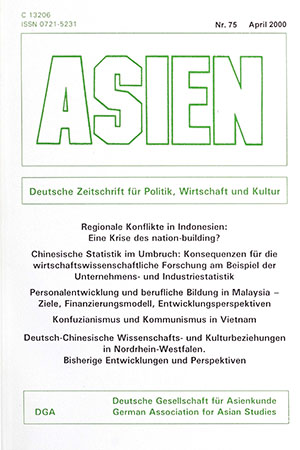
Regionale Konflikte in Indonesien: Eine Krise des nation-building?Klaus H. Schreiner
ASIEN – Nr. 75 (2000) pp. 5–19
Since Suharto’s downfall in May 1998 regional conflicts are wrecking Indonesia’s political landscape, reaching a preliminary peak in August 1999 when the East Timorese constituency voted for independence. There are several distinct patterns of regional conflicts: failure of decolonisation, lack of political participation, the provinces‘ denied share in their own economic wealth, prolonged human rights abuses. The roots of these situation lie in the nation building process in the early years of Indonesian independence flawed by historical misperceptions and ideological distortions. The second cause for current centre-periphery conflicts is the authoritarian centralism of the ousted New Order regime. Moreover some conflict scenarios (e.g. Ambon) are the result of intra-elite rivalries in post-Suharto Indonesia. However, the concept of a decentralised federal state that had been discredited by historical developments in the forties and fifties (Dutch colonialism, Islamic separatism, and the PERMESTA secessionist movement) has viable roots in Indonesian political thinking and can still contribute to the solution of the current situation.