Vietnam

Autor:in Author Expertise Experts Mirjam LeDoktorandin, Lehrbeauftragte Universität Passau Land/Länder/Region Vietnam, Südostasien Arbeitsgebiete/Themen/Keywords Soziale Bewegungen Stadtentwicklung Demokratisierung Autoritarismus Vietnam-China Beziehungen Sprachen fließend: Deutsch, Englisch gut: Vietnamesisch, Französisch Doctoral candidate, lecturer University of Passau Country/Countries/Region Vietnam, Southeast Asia Areas of work/topics/keywords Social movements Urban development Democratisation Authoritarianism Vietnam-China relations Languages Fluent: German, English Good: Vietnamese, French Deutsch German Englisch English Französisch French Vietnamesisch Vietnamese Interviews Print/Web Interviews Radio/Podcast Schriftliche Kommentare Studienorientierung an Schulen Passau Südostasien South-East Asia Vietnam Doktorandin, LehrbeauftragteUniversität PassauLand/Länder/RegionVietnam, SüdostasienArbeitsgebiete/Themen/KeywordsSoziale Bewegungen Stadtentwicklung Demokratisierung Autoritarismus Vietnam-China BeziehungenSprachenfließend: Deutsch, Englischgut: Vietnamesisch, Französisch Doctoral candidate, lecturerUniversity of PassauCountry/Countries/RegionVietnam, Southeast AsiaAreas of work/topics/keywordsSocial movements Urban development Democratisation Authoritarianism Vietnam-China relationsLanguagesFluent: German, EnglishGood: Vietnamese, FrenchAutor:in Author Expertise Experts Sandra Kurfürst, Prof. Dr.Professorin, Universität zu Köln Land/Länder/Region Vietnam, Südostasien (Festland) Arbeitsgebiete/Themen/Keywords Urbanisierung Social Media Entwicklung Jugend Popkultur Gender Sprachen fließend: Deutsch, Englisch gut: Vietnamesisch Professor, University of Cologne Country/Countries/Region Vietnam, Southeast Asia (mainland) Fields of work/Topics/Keywords Urbanisation Social media Development Youth pop culture Gender Languages Fluent: German, English Good: Vietnamese Deutsch German Englisch English Vietnamesisch Vietnamese Interviews Print/Web Interviews Radio/Podcast Keynotes Studienorientierung an Schulen Köln Cologne Südostasien South-East Asia Vietnam Professorin, Universität zu KölnLand/Länder/RegionVietnam, Südostasien (Festland)Arbeitsgebiete/Themen/KeywordsUrbanisierung Social Media Entwicklung Jugend Popkultur GenderSprachenfließend: Deutsch, Englischgut: Vietnamesisch Professor, University of CologneCountry/Countries/RegionVietnam, Southeast Asia (mainland)Fields of work/Topics/KeywordsUrbanisation Social media Development Youth pop culture GenderLanguagesFluent: German, EnglishGood: Vietnamese
Vorstand Executive Yasmin Koppen, Dr.VorstandsmitgliedRegionaler Schwerpunkt Ost- und Südostasien Länderschwerpunkt Vietnam, China (weitere: Indonesien, Philippinen) Fachgebiet Religionswissenschaft, insbesondere Religionsgeschichte; Medizingeschichte Forschungsinteressen Religiöse Räume, sakrale Architektur Ideologie- und Legitimitätstransfer Hydrolatrie (Wasserkulte, Nāga- und Drachenverehrung) Pluralisierung und Nationalisierungsprozesse Religion und Umwelt (Religionisierung von Umweltbewegungen, Umweltdeitäten) Postkoloniale Erinnerungspolitik, Identität und Institutionalisierung in Südostasien Gender, Queerness und religiöse Ausdrucksformen in Ost- und Südostasien …Leipzig China Indonesien Indonesia Ostasien East Asia Philippinen Philippines Südostasien South-East Asia Vietnam Regionaler SchwerpunktOst- und SüdostasienLänderschwerpunktVietnam, China (weitere: Indonesien, Philippinen)FachgebietReligionswissenschaft, insbesondere Religionsgeschichte; MedizingeschichteForschungsinteressen Religiöse Räume, sakrale Architektur Ideologie- und Legitimitätstransfer Hydrolatrie (Wasserkulte, Nāga- und Drachenverehrung) Pluralisierung und Nationalisierungsprozesse Religion und Umwelt (Religionisierungvon Umweltbewegungen, Umweltdeitäten) Postkoloniale Erinnerungspolitik, Identitätund Institutionalisierung in Südostasien Gender, Queerness und religiöse Ausdrucksformen in Ost- und SüdostasienPosition und InstitutionPostdoktorale Forschungsmitarbeiterin am Religionswissenschaftlichen Institut der Universität LeipzigBioYasmin Koppen ist Religionswissenschaftlerin an der Universität Leipzig. Sie studierte Religionswissenschaft und Sinologie an der Ruhr-Universität Bochum und spezialisierte sich früh auf Vietnam. Ihre Forschung untersucht religiöse Räume und deren Transformationen in China und Vietnam, mit besonderem Fokus auf Hydrolatrie, Ideologietransfer und die Aushandlung von Identität. Ihre Arbeit verbindet raumtheoretische Ansätze, Religionsgeschichte und postkoloniale Perspektiven. Als neues Projekt geht es um die Religionisierung indigenen Umweltaktivismus.Bisherige Funktionen in der DGA Sprecherin der Nachwuchsgruppe (DGA Young Scholar Group) kooptiertes VorstandsmitgliedVorhaben für die künftige Vorstandsarbeit Stärkung des wissenschaftlichen Mittelbaus und Förderung interdisziplinärer Vernetzung Ausbau digitaler Sichtbarkeit und barrierefreier Strukturen Thematische Erweiterung um Fragen von Umwelt, Gender und Queerness in Asienstudien Beitrag zu einem fairen, diversen und dekolonialisierten Wissenschaftsbetrieb Begründung eines Arbeitskreises Geschichte Ostasiens Förderung der Gesellschaftsaktivitäten und des WebsiteausbausMitgliedschaft in DGA-Arbeitskreisen Nachwuchsgruppe (NWG) AK Südostasien (SOA)Mitgliedschaft in weiteren Vereinen/Gesellschaften Deutsche Vereinigung für Religionswissenschaft (DVRW), Sprecherin des Arbeitskreises Mittelbau, Sprecherin des Arbeitskreises Religion, Sammeln, Ausstellen International Association for Buddhist Studies (IABS) Wort-Wirkung-Wunder (DFG-Netzwerk) Deutsche Vereinigung für Chinastudien (DVCS)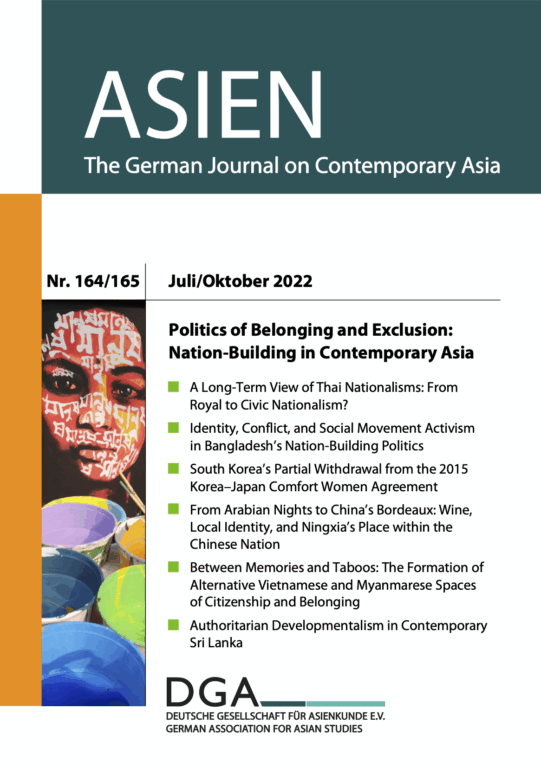 Nr. 164/165 (2022) Research Note 117–39 {:en}Between Memories and Taboos: The Formation of Alternative Vietnamese and Myanmarese Spaces of Citizenship and BelongingIn the postcolonial states of Southeast Asia, governments weaponize their histories to create spaces of legitimate memories for nation-building processes.Local identities that do not conform to the official historiography are silenced. Beyond these state-sanctioned boundaries, however, alternative practices of remembrance are upheld that can challenge the state to produce different forms of belonging, identity, and …
 von by Franziska Susana Nicolaisen, Mirjam Leund and Mandy Fox
Themenschwerpunkt Feature 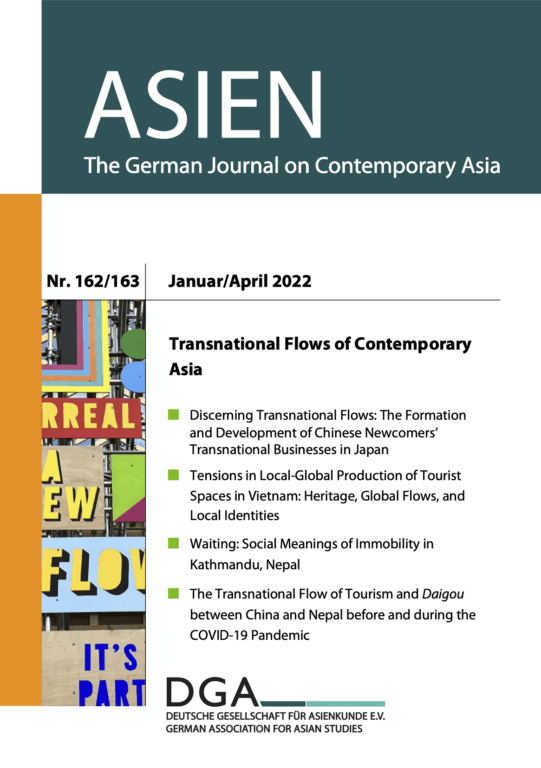 Nr. 162/163 (2022) Research Note 34–57 {:en}Tensions in Local-Global Production of Tourist Spaces in Vietnam: Heritage, Global Flows, and Local IdentitiesThis research note examines the relations between mobility, urban heritage, and locality in Vietnam. The main research question is: Can heritage preservation function as a decolonization project, or does it re-establish structures of internal coloniality? We analyze data on Hội An and Tam Đảo regarding narratives, appropriation, and consumption practices and link our findings to …
 von by Mirjam Leund and Franziska Susana Nicolaisen
Themenschwerpunkt Feature 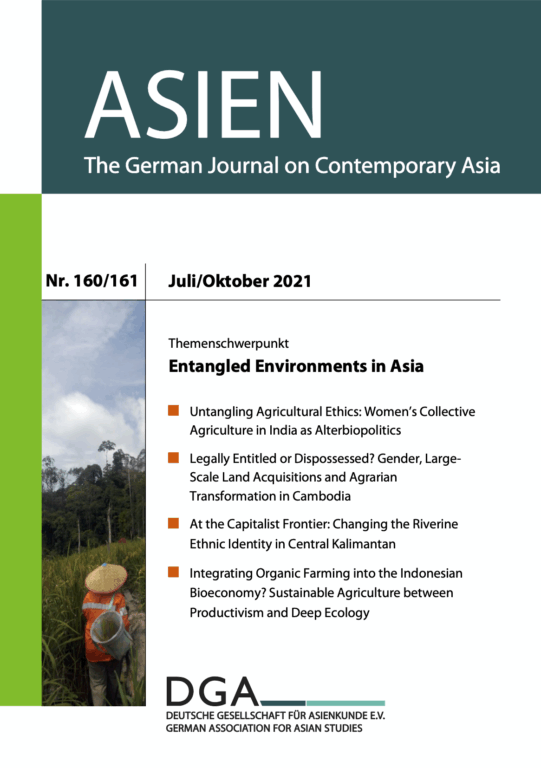 Nr. 160/161 (2021) Research Note 169–84 {:de}Vietnam unter der Herrschaft der „Partei-Staat- Unternehmens-Allianz“ – Herausforderungen für die Zivilgesellschaft im Jahr 2021Vietnam’s civil society continues to face major challenges in 2021: A hegemonic “party-state-business alliance”, which occupies all political and economic “commanding heights” and is also ideologically in a relatively strong position not least due to the lack of practicable alternatives, has a civil society as an opposite that is deliberately divided. Numerically strong it is …
 von by Jörg Wischermann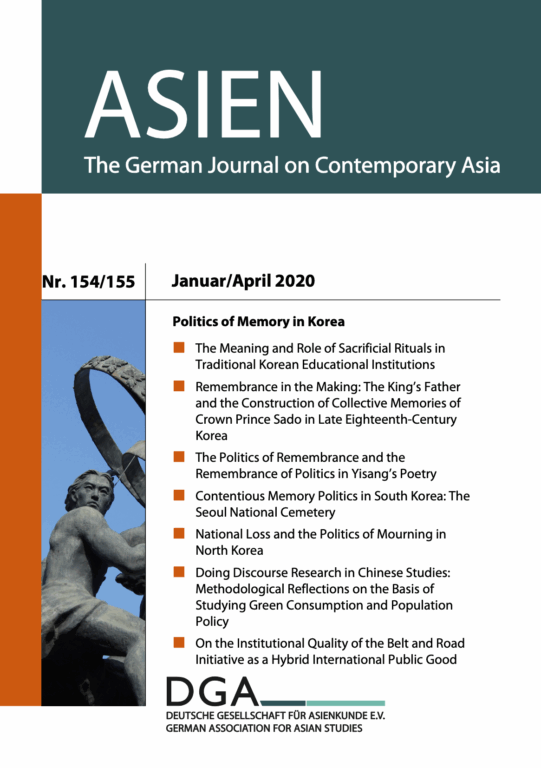 Nr. 154/155 (2020) Rezensionen 163–64 {:en}Catherine Earl (ed.): Mythbusting Vietnam: Facts, Fictions, FantasiesNIAS Press, 2018. 254 pp., 65 GBP (Hardback); 22.50 GBP (Paperback) The collected volume “Mythbusting Vietnam: Facts, Fictions, Fantasies” aims to discuss problematic axiomatic knowledge and to raise alternative possibilities in knowledge production processes and practices in Vietnam Studies through interdisciplinary and methodologically diverse approaches. The book is based on the idea of “mythbusting”, which …
 von by Friederike Trotier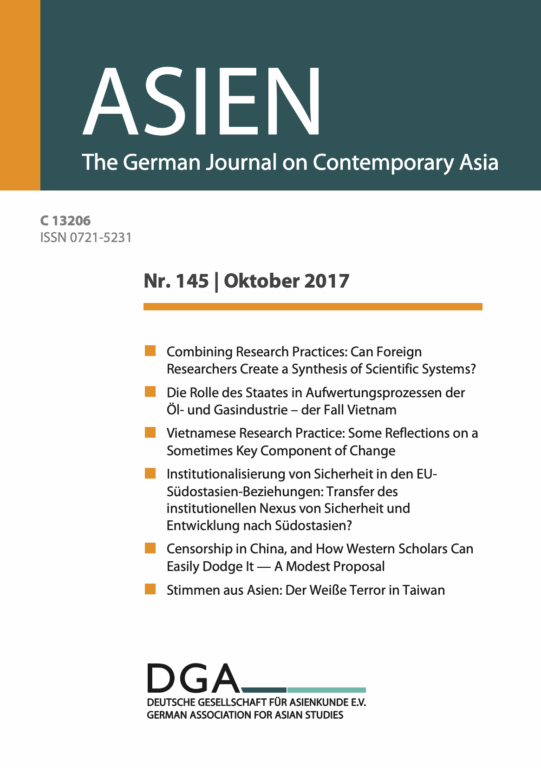 Nr. 145 (2017)
 Artikel Article 5–23 {:en}Combining Research Practices: Can Foreign Researchers Create a Synthesis of Scientific Systems?Why should Germans conduct research in Vietnam if there are Vietnamese researchers who could do this work? This is the question that this article tries to answer. By presenting two different research projects that were implemented in Vietnam by German researchers, the special role that what we call the “transcultural researcher” holds will be analyzed. …von by Eva Fuhrmannund and Kerstin Schiele- Nr. 145 (2017)
Artikel Article 24–44 {:de}Die Rolle des Staates in Aufwertungsprozessen der Öl- und Gasindustrie – der Fall VietnamStarting with the doi moi reforms, Vietnam has gradually been integrated into the global production network (GPN) of the oil and gas industry. However the mere integration into these global production processes does not guarantee regional economic outcomes; this depends, rather, on the exact position within the GPN. In these industries especially, states can play …von by Linus Kalvelageund and Moritz Breul - Nr. 145 (2017) Research Note 45–64 {:en}Vietnamese Research Practice: Some Reflections on a Sometimes Key Component of ChangeThe paper broaches the general research issue of whether there are distinct characteristics to common Vietnamese methods of knowledge production, drawing upon the author’s own experiences. It examines various policy documents, and frames its analysis of the implied methods used to produce them through reference to existing research. It is suggested that Vietnamese are ‘catholic’ …
von by Adam Fforde 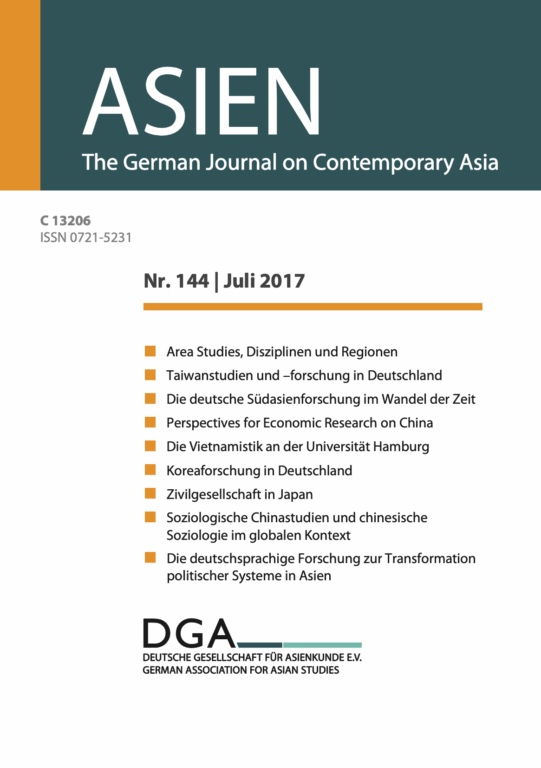 Nr. 144 (2017)
 Artikel Article 70–93 {:de}Die Vietnamistik an der Universität HamburgVietnamese Studies are about the language and culture of the Vietnamese people. This academic subject first originated in France in the 19th century. In the 20th century, the United States and Eastern Europe became new centres of Vietnamese Studies research. Nowadays, it is the country’s Asian neighbours who are developing this academic field more extensively. …von by Thomas Engelbert
Studium Information Study Information {:de}Vietnamistik (Universität Hamburg)https://www.aai.uni-hamburg.de/soa/ueber-die-abteilung/geschichte.html#uhh-tabs-0_tab-2 Gegenwärtige Forschungsschwerpunkte bilden die moderne Geschichte Vietnams unter besonderer Berücksichtigung des Südens, ethnische Entwicklungen und die Beziehungen zwischen Vietnam, Laos und Kambodscha, Vietnam und China sowie die Volksliteratur der Việt. In der Lehre wird das Bemühen darauf gerichtet sein, das Fach in seiner ganzen Breite unter besonderer Berücksichtigung der Sprache, Literatur und Geschichte zu …Bachelor Master Promotion Vietnamistik Hamburg Vietnam https://www.aai.uni-hamburg.de/soa/ueber-die-abteilung/geschichte.html#uhh-tabs-0_tab-2Gegenwärtige Forschungsschwerpunkte bilden die moderne Geschichte Vietnams unter besonderer Berücksichtigung des Südens, ethnische Entwicklungen und die Beziehungen zwischen Vietnam, Laos und Kambodscha, Vietnam und China sowie die Volksliteratur der Việt. In der Lehre wird das Bemühen darauf gerichtet sein, das Fach in seiner ganzen Breite unter besonderer Berücksichtigung der Sprache, Literatur und Geschichte zu vertreten. Seit 2006 gibt es endlich auch ein festes Vietnamesisch-Lektorat, das Herr Cao Quang Nghiệp, Absolvent der Hamburger Vietnamistik, ausfüllt. Er arbeitet gegenwärtig auch an einer Promotion zur Literaturgruppe „Tự Lực Văn Đoàn“. Vier weitere Promovenden schreiben zurzeit Dissertationen über Sprachwissenschaft und Literatur.KontaktUniversität HamburgFakultät für GeisteswissenschaftenAsien-Afrika-InstitutAbteilung für Sprachen und Kulturen SüdostasiensEdmund-Siemers-Allee 1 (Flügel Ost)20146 HamburgTelefon: +49 40 2395-22691E-Mail: suedostasien@uni-hamburg.de (Ansprechpartnerin Angelika Finch)AbschlüsseBachelor: BA Sprachen und Kulturen Südostasiens – Schwerpunkt VietnamistikMaster: International Master Programme Languages and Cultures of Southeast AsiaPromotion / Graduiertenkolleg: Promotion Austronesistik/Thaiistik/Vietnamistik/Geschichte Südostasiens Nr. 131 (2014)
 Artikel Article 25–45 {:en}The Quest to be a “Human Rights Promoter”: The European Union and the Case of VietnamRecently the political weight of the European Union (EU) in international relations has come under scrutiny. Alongside economic influence, normative power is among the key factors shaping the EU’s foreign policy. In spite of the EU’s efforts at establishing legitimate norms that can be globally exported and applied and its actions to promote these norms …von by Tien Phamund and Vu Truong Nr. 121 (2011) Asien Aktuell 59–76 {:en}Smoldering Conflicts in the South China Sea“There are hundreds of small islands in the South China Sea, along with several underwater features, namely, uninhabited islets, shoals, reefs, banks, sands, cays and rocks. According to Workman, these islands mainly consist of coral reefs and are mainly categorised into four groups: the Pratas Islands (Dongsha qundao in Chinese), the Paracel Islands (Xisha qundao …
 von by Tilman Pradt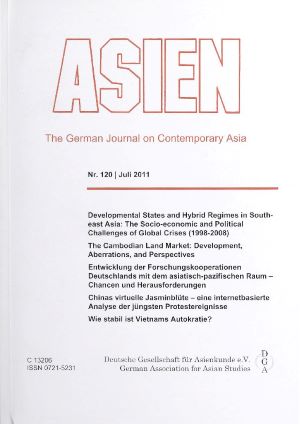 Nr. 120 (2011) Asien Aktuell 82–90 {:de}Wie stabil ist Vietnams Autokratie?Ich möchte hier auf Kritik an dem Stabilitätsbegriff von Schmidt verzichten und mich, da Sie alle mehr an der aktuellen ökonomischen und politischen Verfasstheit Vietnams, vielleicht auch im direkten Vergleich mit Ländern wie Tunesien und Ägypten, interessiert sind, auf drei seiner Kriterien beschränken und auf der Grundlage meiner Befunde Ihnen drei Thesen zu der Frage …
 von by Jörg Wischermann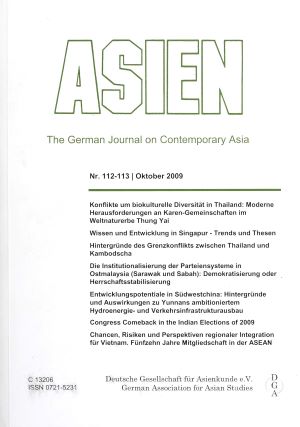 Nr. 112/113 (2009) Asien Aktuell 130–40 {:de}Chancen, Risiken und Perspektiven regionaler Integration für Vietnam – Fünfzehn Jahre Mitgliedschaft in der ASEANMit der Übernahme des Vorsitzes in der ASEAN im Jahr 2010 ist für die Sozialistische Republik Vietnam auch der Zeitpunkt gekommen Bilanz der fünfzehn Jahre Mitgliedschaft in der südostasiatischen Staatengemeinschaft zu ziehen. Betrachtet man die Verlautbarungen von Premierminister Nguyễn Tấn Dũng, so scheint diese Bilanz in der Wahrnehmung der politischen Elite Vietnams durchaus positiv auszufallen: …
 von by Andreas Grimmel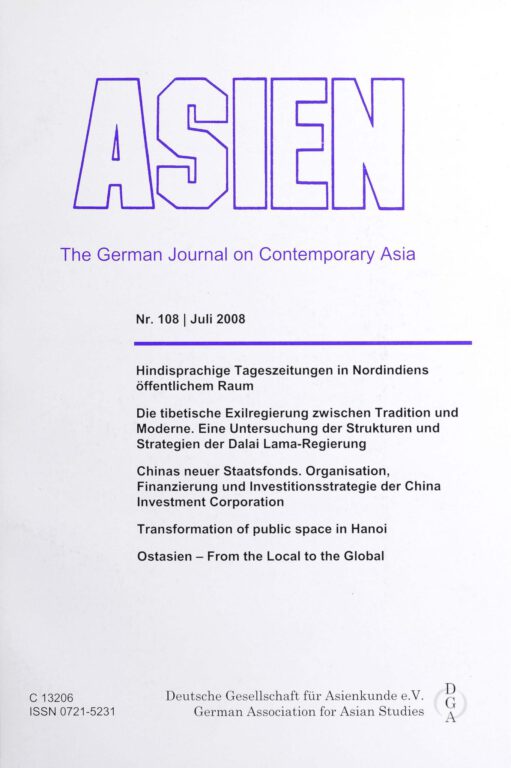 Nr. 108 (2008) Research Note 67–79 {:de}The Transformation of Public Space in HanoiThe following article is a research note concerning an ongoing project on the transformation of public space in Hanoi, Vietnam. The research itself focuses on the changes in power relations between the state and society and how these are reflected in the physical environment of the city. Since the introduction of the Vietnamese Doi Moi …
 von by Sandra Kürten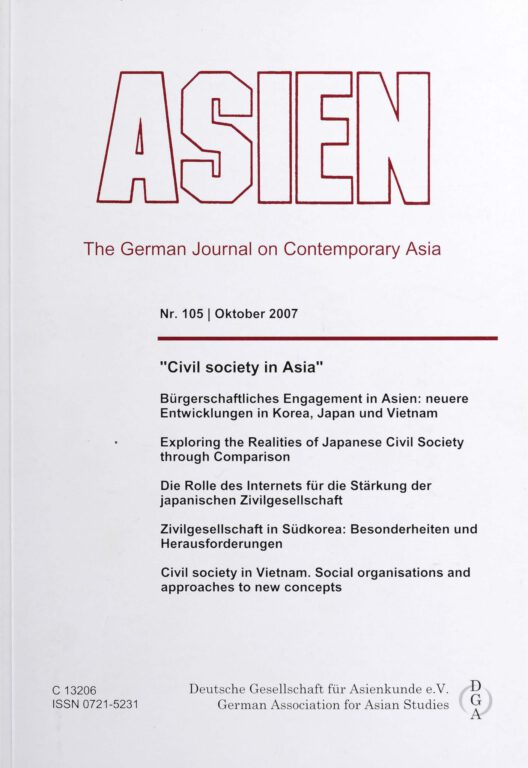 Nr. 105 (2007)
 Artikel Article 7–15 {:de}Einleitung – Bürgerschaftliches Engagement in Asien: neuere Entwicklungen in Korea, Japan und VietnamThe emergence of a vivid civil society in Asian countries has become the focus of scientific interest for at least one decade. Until now some international surveys have presented basic data concerning the quantity and quality of civil society in various Asian countries. They allow rough descriptions concerning similarities and differences. South Korea, Japan and …von by Gesine Foljanty-Jost- Nr. 105 (2007)
Artikel Article 68–90 {:en}Civil Society in Vietnam. Social Organisations and Approaches to New ConceptsThe concept of civil society is not familiar in the Vietnamese context, which is based on Marxist-Leninist concepts in the official political terminology of the one-party state maintained by the Communist Party. However, the term is increasingly being employed by scholars and practitioners, and even the state is beginning to open up to its use. …von by Irene Nørlund  Nr. 103 (2007)
 Artikel Article 59–78 {:en}Housing for Low-income Groups in Ho Chi Minh City between Re-Integration and Fragmentation. Approaches to Adequate Urban Typologies and Spatial StrategiesThe metropolitan region of Ho Chi Minh City has been the greatest beneficiary of the ongoing transitional process in Vietnam, but this has been accompanied by a sharp rise of social polarization and spatial fragmentation. This paper analyzes the housing sector as an example of the complex dynamics of the transitional urban development. One of …von by Michael Waibel, Ronald Eckert, Michael Boseund and Volker Martin
Themenschwerpunkt Feature  Nr. 92 (2004)
 Artikel Article 30–48 {:en}The Ancient Quarter of Hanoi – A Reflection of Urban Transition ProcessesThis paper describes the effects of the Doi Moi policy, the latest stage in a series of historical transitions, on the urban landscape of Vietnam's oldest existing trade, market, and retail estate, the Ancient Quarter of Hanoi or 36 Streets Quarter. Economic liberalisation and the opening up to global capital have caused an enormous economic …von by Michael Waibel Nr. 85 (2002)
 Artikel Article 61–83 {:de}Die Entstehung, Entwicklung und Struktur von Civic Organizations und deren Verhältnis zu Governmental Organizations in VietnamFor many years it was quite common for American and European political scientists to analyze the Vietnamese political system in that they presupposed a mono‐organizational mode of state‐society relations and used an appropriate model for such. Quite obviously such models are not or are no longer appropriate, since current social research indicates that a variety …von by Jörg Wischermann Nr. 81 (2001)
 Artikel Article 7–31 {:de}Perspektiven der landwirtschaftlichen Genossenschaften in VietnamDuring the late 1980s Vietnam started a process of decollectivisation in agricultural production. All land had been distributed among the farm families. The former agricultural production cooperatives lost their raison d'être. They had either to transform themselves into modern service cooperatives promoting the farm production of their members or to cease to exist. With the …von by Axel Wolz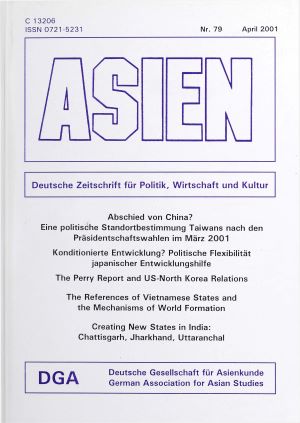 Nr. 79 (2001)
 Artikel Article 62–86 {:en}The References of Vietnamese States and the Mechanisms of World FormationThe article provides a method of exploring ideational polities, which proceeds through highlighting the networks of discursive reference, which are made to argue for the nature or existence or right to existence of a given polity. This method enables a comparative study of the state. As case studies, four paramount conceptions of Vietnamese states in …von by Alexander L Vuving
Suchen Search
Schlagwörter Tags
Aktuelles von unseren Mitgliedern Member News (3)- Art (5)
ASIEN (Zeitschrift) ASIEN (Journal) (16)Auszeichnung Award (12)Bericht Report (127)Bildung Education (22)- Calls for… (1230)
- Cinema (4)
- DGA (89)
Diskussion Roundtable (73)- Fellowship (111)
Forschung Research (225)- Geografie (2)
Geschichte History (93)Gesellschaft Society (277)Globalisation Globalization (7)- Hybrid (172)
Kultur Culture (25)- Kunst (4)
- Lecture (94)
Literatur Literature (260)Medien Media (24)- Migration (39)
- Nationalism (6)
- Online (235)
Philosophie Philosophy (12)Politik Politics (414)Politikwissenschaften Political Sciences (13)- Praktikum (8)
- Präsentation (13)
Programm Program (5)Publikation Publication (22)Recht Law (20)- Religion (75)
- Sozialwissenschaften (4)
Sprache Language (36)- Sprachkurse (8)
Stellenausschreibung Job Advertisement (654)Stipendium Grant (52)Studium Study (21)- Summer School (10)
Symposium Symposia (32)Tagung Conference (498)Tourismus Tourism (14)Umwelt Environment (45)Veranstaltung Events (750)- Webinar (28)
Wirtschaft Economy (199)- Workshop (126)
Arbeitskreise Working Groups Working Groups
Kategorien Category
- ASC (31)
- DGA News (57)
Nachwuchsgruppe YSG (62)Neuzeitliches Südasien South Asia (12)Südostasien Southeast Asia (1)
Browse by
Länder Country
- Afghanistan (30)
Afrika Africa (22)- ASEAN (48)
Asien Asia (580)Asien-Pazifik Asia-Pacific (63)Australien Australia (4)- Austronesien (3)
Bangladesch Bangladesh (30)- China (1496)
- Deutschland (3)
Eurasien Eurasia (2)Europa Europe (36)- Fiji (3)
- Hong Kong (95)
Indien India (225)Indochina Indo-China (5)Indonesien Indonesia (95)- Japan (506)
Kambodscha Cambodia (30)- Korea (208)
- Laos (5)
- Lateinamerika (2)
- Macau (4)
- Malaysia (30)
Mongolei Mongolia (57)- Myanmar (17)
Naher Osten Middle East (10)- Nepal (9)
Neuseeland New Zealand (4)Ostasien East Asia (289)Osttimor East Timor (4)- Pakistan (31)
Papua-Neuguinea Papua New Guinea (5)Philippinen Philippines (34)Rußland Russia (14)Singapur Singapore (24)- Sri Lanka (25)
Südasien South Asia (170)Südostasien South-East Asia (235)- Taiwan (334)
- Thailand (41)
- Tibet (19)
UdSSR USSR (13)- USA (57)
- Uzbekistan (2)
- Vanuatu (2)
- Vietnam (46)
Zentralasien Central Asia (41)
Mitgliedschaft Membership Membership
Orte Locations
- Amsterdam (3)
- Augsburg (3)
- Berlin (107)
- Bielefeld (2)
- Bochum (23)
- Bonn (33)
- Bremen (19)
- Duisburg-Essen (44)
- Erfurt (3)
- Erlangen-Nürnberg (16)
- Frankfurt am Main (33)
- Freiburg (28)
- Göttingen (14)
- Halle (12)
- Hamburg (61)
- Heidelberg (36)
- Jena (7)
- Kiel (3)
Köln Cologne (29)- Konstanz (6)
- Kopenhagen (2)
- Leipzig (17)
- Ludwigshafen am Rhein (2)
- Mainz (3)
- München (6)
- Münster (5)
- Passau (6)
- Rostock (8)
- Stuttgart (2)
- Trier (8)
- Tübingen (40)
Wien Vienna (42)- Würzburg (17)
Zürich Zurich (10)