Frauke Kraas
 Nr. 150/151 (2019)
 Artikel Article 5–27 {:de}Wertschöpfungsketten von Luxustextilien in DelhiIn the last three decades, Delhi has witnessed the emergence of an independent textile industry that focuses on the production of highly specialized luxury garments. Until the 1980s, the Indian garment industry was mainly characterized by self- employed, locally operating tailors, and unorganized retailers. By that time, a few innovative entrepreneurs had identified the potential …von by Carsten Butsch, Tine Trumpp, Pit C. Fuistingund and Frauke Kraas Nr. 149 (2018)
 Konferenzen Conferences 131–32 {:de}Arbeitskreis Südostasien: Jahrestagung 2018Universität Heidelberg, 8.–10. Juni 2018 Gastgeber der Tagung des Arbeitskreises Südostasien in der Deutschen Gesellschaft für Geographie (DGfG) war das Geographische Institut der Universität Heidelberg. Unter der sorgfältigen, gastfreundlichen lokalen Organisation von Prof. Dr. Hans Gebhardt und Dr. Simon Runkel wurde das 25. Jahrestreffen des Arbeitskreises zwischen dem 8. und 10. Juni 2018 durchgeführt. Für …von by Michael Koch, Frauke Kraasund and Javier Revilla Diez Nr. 141 (2016)
 Konferenzen Conferences 93–95 {:de}20 Jahre Arbeitskreis Südostasien in der Deutschen Gesellschaft für Geographie: „Recent Spatial Dynamics in Southeast Asia“Jahrestagung in Köln, 2./3. Juli 2016 Der 1996 gegründete Arbeitskreis Südostasien feierte mit seiner Jahrestagung Anfang Juli 2016 sein 20-jähriges Bestehen, dieses Mal im Geographischen Institut der Universität zu Köln. Mit 48 TeilnehmerInnen aus verschiedenen Teilen Deutschlands und Österreichs waren zahlreiche KollegInnen, DoktorandInnen und ExamenskandidatInnen verschiedener Disziplinen vertreten, die in 15 Vorträgen aktuelle Forschungsarbeiten aus …von by Frauke Kraasund and Javier Revilla Diez Nr. 139 (2016)
 Konferenzen Conferences 123–24 {:en}The 13th International Asian Urbanization ConferenceYogyakarta, Indonesia, January 6-8, 2016 The 13th International Asian Urbanization Conference on “Rapid Urbanization and Sustaina ble Development in Asia” was hosted by the Faculty of Geography, Universitas Gadjah Mada, in association with the Asian Urban Research Association (AURA). Since 30 years, this conference series is dedicated to the exchange of views and research on …von by Christian Obermayr, Simone Sandholzund and Frauke Kraas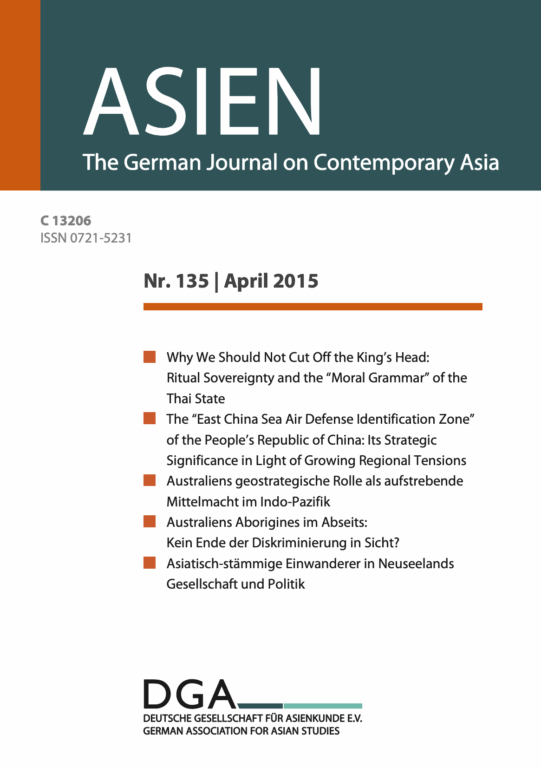 Nr. 135 (2015)
 Artikel Article 73–93 {:en}How is Rapid Urbanization in India Affecting Human Health? Findings from a Case Study in PuneRapid urbanization in Africa and Asia is currently changing environmental and societal living conditions for a large number of people. In urban India specifically, the deterioration of local natural environments, the inadequate provision of infrastructure, and socioeconomic disparities are collectively resulting in a “double burden” of disease — namely, high morbidity from both communicable diseases …von by Carsten Butsch, Mareike Kroll, Frauke Kraasund and Erach Bharucha
Themenschwerpunkt Feature 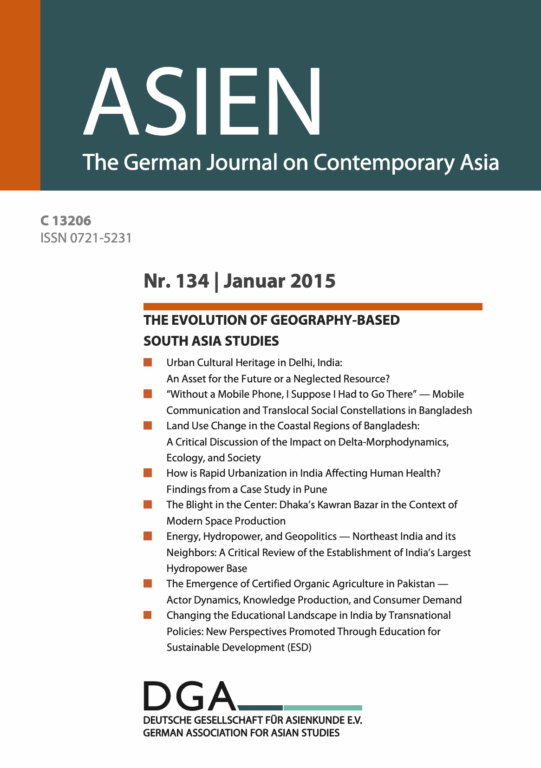 Nr. 134 (2015)
 Artikel Article 9–29 {:en}Urban Cultural Heritage in Delhi, India: An Asset for the Future or a Neglected Resource?The attractiveness of cities and their national and international competitiveness are partly determined by “soft” and “intangible” factors: cultural, social, and individual aspects are becoming the basis for the “unique competitive edge” that cities have and play a crucial role with regard to the creation of identity. In Delhi, every epoch of the city’s rich …von by Tine Trumppund and Frauke Kraas
Themenschwerpunkt Feature  Nr. 103 (2007) Editorial 7–8 {:en}Megacities in AsiaThis year, in 2007, according to the United Nations, more than half of the world’s population live in cities – an increase from 30% in 1950 to 47% in 2000 – and the increase will probably reach 60% in 2030. Particularly in developing countries of Asia and Africa urbanization is proceeding rapidly. Megacities, i.e. cities …
 von by Frauke Kraas
Themenschwerpunkt Feature - Nr. 103 (2007)
Artikel Article 9–22 {:en}Megacities and Global Change in East, Southeast and South AsiaMegacities have particular significance in the world-wide process of urbanisation: In the year 2015, more than 600 million people will be living in about 60 megacities worldwide (i.e. metropolises with more than 5 million people). Under the dynamics of global change they affect global change just as profoundly as global change can affect megacities. Often, …von by Frauke Kraas
Themenschwerpunkt Feature  Nr. 74 (2000)
 Artikel Article 50–64 {:de}Forschungsfragen und -desiderate zu Südostasien aus geographischer SichtThe article focuses on the research topics and emphasis of German Geographical Research on South East Asia and is also to be seen as a contribution to the recent discussion on the role and importance of Asian Sciences at German universities. The article describes the main topics of the past 50 years of research and …von by Frauke Kraasund and Ulrich Scholz